What is Soil Bearing Capacity?
Table of Contents
- Understanding the Ground’s Ability to Carry Load
- Types of Bearing Capacity
- What Influences Bearing Capacity?
- Establishing Values for Foundations
- Bearing Capacity vs Bearing Pressure
- Improving Support Through Ground Engineering
- How Bearing Resistance Works in Piling
- Resistance Bearing Within Retaining Walls
Last updated
22 October 2026
Understanding the Ground’s Ability to Carry Load
Soil bearing capacity is the ability of soil or rock to support loads applied by a foundation without experiencing bearing failure or unacceptable settlement. It influences how a structure is supported and whether shallow foundations, piling or ground improvement are appropriate.
Ultimate bearing capacity refers to the pressure at which the supporting ground fails. Foundations provide a margin against this failure and consider settlement separately. The usable support therefore depends on both ground strength and acceptable movement.
Types of Bearing Capacity
Bearing capacity values describe different limits and use different reference points. Understanding these distinctions helps explain how engineers move from assessing ground failure to selecting a suitable foundation pressure.
Ultimate bearing capacity is the pressure beneath a foundation at which the supporting ground reaches bearing failure. The soil can no longer sustain the load without substantial deformation.
Allowable bearing capacity is a working pressure established by applying a factor of safety to the ultimate value. Settlement is also checked and may require a lower pressure to keep movement within acceptable limits.
Gross and net bearing capacity distinguish how pressure is expressed. Gross values include the total pressure at foundation level. Net values account for the pressure previously exerted by the soil above that level, describing the increase associated with construction.
These terms address different aspects of the assessment. A value can therefore be both ultimate and net, or allowable and gross.
What Influences Bearing Capacity?
Bearing capacity depends on the ground and the arrangement transferring load into it. Principal influences include:
- Soil and rock properties: shear strength, density and geological structure affect the ground’s ability to resist loading.
- Foundation dimensions: width, shape, and depth influence the volume of ground supporting the load.
- Layer thickness: a strong surface layer may overlie weaker deposits that affect performance.
- Groundwater conditions: groundwater levels and pore water pressure can influence the effective stresses within the soil and therefore its bearing resistance.
- Load position and direction: inclined or offset loads create a different pressure distribution from a central vertical load.
- Nearby slopes and excavations: changes in ground geometry can reduce the support available around a foundation.
These factors explain why a bearing value relates to particular foundation conditions rather than being a fixed property of an entire site.
Establishing Values for Foundations
Ground investigation identifies the strata beneath proposed works and provides information about their engineering properties. Boreholes, trial pits, SPT and CPT testing, and laboratory results help develop the ground model used in the assessment.
Engineers combine this evidence with foundation dimensions and loading to calculate resistance. They also examine the depth of ground affected by construction and the movement likely to develop.
A plate loading test can provide additional information about responses beneath a test area. Its interpretation accounts for the plate size and the depth of material influence.
The resulting assessment informs foundation sizing, founding levels and the need for treatment or deeper support.
Bearing Capacity vs Bearing Pressure
Bearing capacity describes the ability of the ground to resist loads without failure, while bearing pressure is the pressure applied to the ground by a foundation. Engineers assess the pressure imposed by the foundation against the resistance available from the ground, while also considering settlement and other performance requirements.
Improving Support Through Ground Engineering
Where existing ground provides insufficient support, treatment can change its behaviour. Compaction densifies suitable loose material, while replacement introduces fill to replace unsuitable near-surface deposits.
Rigid inclusions use columns in a load-transfer arrangement to share loading with the surrounding ground. This can improve foundation support while controlling settlement.
Grouting offers further options. Compaction grouting displaces and densifies suitable soils, whereas jet grouting forms treated soil-cement elements. Selection depends on the geology, loading, and available access.
The aim is to match foundation demands with dependable ground performance. Bearing resistance, anticipated movement and construction practicality are considered together to establish a suitable solution.
How Bearing Resistance Works in Piling
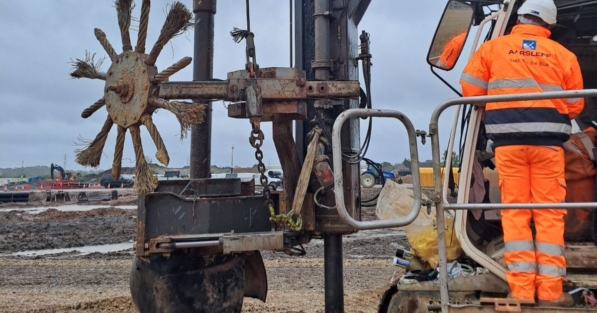
Piles transfer loads through resistance beneath their toe and along their shaft. End bearing describes the contribution from the base, while shaft resistance develops through contact with the surrounding soil or rock.
Driven precast concrete piles and steel bearing piles can carry loads through weaker deposits into suitable deeper strata. Their installation can also alter the surrounding ground, influencing the resistance developed.
For CFA piles and rotary bored piles, drilling and concrete placement affect the completed foundation’s performance. Where toe resistance forms a significant part of a bored pile’s design, the condition of the excavated base is particularly important.
Pile assessment brings these contributions together, along with structural strength and group behaviour, to establish the available support.
How Bearing Capacity Affects Retaining Walls
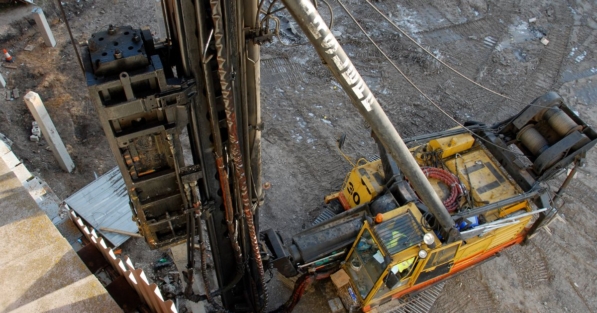
Retaining walls must resist the forces from retained ground while transferring loads into their foundations. For gravity and reinforced concrete cantilever walls, bearing checks assess the pressure beneath the base.
Earth pressure creates an overturning effect that can concentrate loading towards one edge. Base width and foundation level therefore influence both stability and ground-pressure distribution.
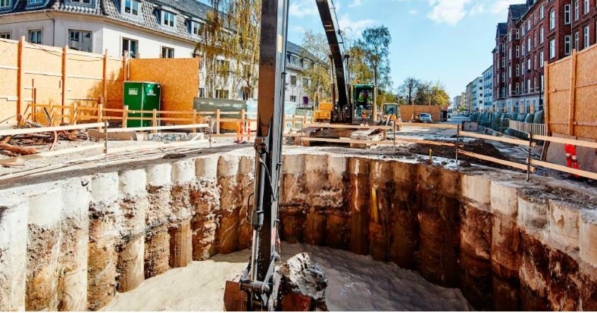
Embedded systems, including sheet piling and secant pile walls, rely substantially on lateral ground resistance. Where these walls also carry vertical structural loads, axial capacity requires assessment.
Ground anchors can provide additional restraint against lateral movement, changing the forces within the wall and its supports. Their contribution is considered as part of the complete retaining arrangement.

Written by Aarsleff UK
22 October 2026
Aarsleff Ground Engineering is a leading sheet piling supplier and contractor. We specialise in designing and delivering sheet piling solutions across the UK.

Reviewed by Mark Fuller, Piling Director
7 October 2026
Mark Fuller is the Piling Director at Aarsleff Ground Engineering. He has amassed a wealth of experience and knowledge within the specialist piling and ground engineering industry throughout his 20 years of experience in the industry. Mark is directly responsible for the overall driven piling within the business, including technical and operational management of awarded contracts, development of strategic long-term plans and planning of recruitment and resource.
Close