What Are End Bearing Piles?
Table of Contents
- Understanding End Bearing Piling
- How Loads Reach the Bearing Layer
- What Makes a Suitable Bearing Stratum?
- Where Are End Bearing Piles Used?
- Construction Factors That Affect Performance
- End Bearing Compared With Shaft Friction
- Checking Performance After Installation
Last updated
22 October 2026
Understanding End Bearing Piling
End bearing piles are deep foundation elements that transfer structural loads primarily through their base, or toe, into a strong soil or rock layer. They pass through weaker deposits to reach ground that can provide the required support.
The term describes how a pile carries load, not its material or installation method. Driven precast concrete piles, steel bearing piles and suitable cast-in-place concrete piles can all develop end-bearing resistance.
How Loads Reach the Bearing Layer
Loads from a building or other structure pass into the pile through its foundation connection. The shaft carries these forces downwards, and pressure beneath the toe mobilises resistance in the bearing layer.
Some movement is needed to develop that resistance. End bearing foundations therefore still require settlement assessment, even where piles reach rock.
Resistance can also develop along the shaft through contact with surrounding ground. In practice, many foundations combine both mechanisms; describing a pile as end bearing identifies the principal source of support rather than excluding every contribution from shaft friction.
What Makes a Suitable Bearing Stratum?
A bearing stratum must be strong and stiff enough to support the design loads. Dense sand, gravel or competent rock may provide suitable founding conditions, depending on their properties and the proposed pile arrangement.
Thickness matters as well as strength. A thin, hard layer over softer deposits may not provide adequate support, while weathered or fractured rock can behave differently from intact material.
Ground investigation should establish:
- Depth and continuity: whether the target layer extends across the foundation footprint.
- Strength and stiffness: how the material will resist loading and deform.
- Underlying conditions: whether weaker deposits could affect performance beneath the pile toe.
- Groundwater conditions: how water may influence excavation and construction.
- Obstructions and variability: whether boulders, old foundations or changing strata could complicate installation.
These findings help determine pile founding levels. Piles on the same site may need different lengths to reach an appropriate bearing stratum.
Where Are End Bearing Piles Used?
End bearing foundations suit projects where shallow ground cannot adequately support the proposed structure and a suitable deeper stratum is reachable. Residential, commercial and institutional applications include apartment buildings, warehouses, hospitals and university facilities.
Infrastructure and rail schemes may use them beneath bridges, station structures and other heavily loaded foundations. Marine applications include jetties and quay structures, while energy projects can require piled support for generating facilities, substations and wind turbine foundations.
Selection remains specific to the site. The presence of a suitable bearing stratum must be considered alongside access, construction constraints and the loads requiring support.
Construction Factors That Affect Performance
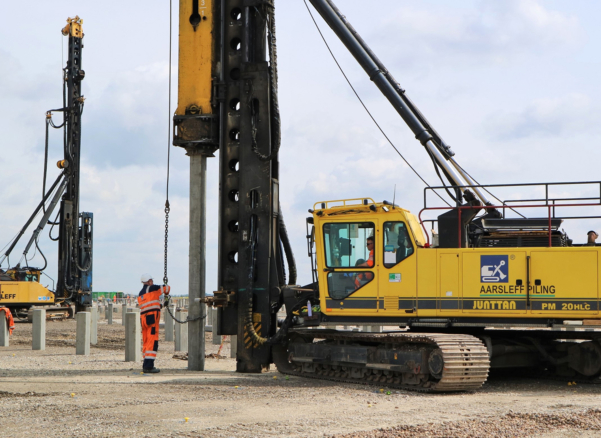
Installation can influence how an end bearing pile performs. Driven piles must withstand handling and hammer stresses, with equipment and driving criteria selected to limit damage. Unexpected resistance requires investigation because buried obstructions can resemble the intended bearing layer.
For rotary bored piles, loose material left at the bottom of the excavation can compress under loading and increase settlement. Bore stability and base cleaning therefore require particular attention before concreting.
CFA piling relies on coordinated auger withdrawal and concrete delivery to maintain pile continuity. These method-specific controls help ensure the installed foundation reflects the assumptions made during design.
End Bearing Compared With Shaft Friction
Friction piles obtain most of their resistance along the shaft, which can be useful where a strong bearing layer lies beyond a practical installation depth. End-bearing solutions rely more on conditions beneath the toe.
Neither mechanism automatically offers the better foundation. Designers assess available resistance, anticipated settlement, pile group behaviour and construction feasibility together.
Settling ground around a pile can also apply downward drag along its shaft, known as negative skin friction. This additional action requires consideration even when the toe bears within a strong stratum.
Checking Performance After Installation
Construction records help confirm pile lengths, encountered conditions and compliance with the installation specification. Appropriate pile load testing can assess how selected piles respond to applied forces.
Pile integrity testing serves a different purpose: it investigates aspects of the pile’s physical condition and does not independently prove its load-bearing capacity.
Bringing these checks together with the ground investigation provides a clearer basis for assessing the completed foundations. The aim is to achieve both the required support and movement limits suited to the structure above.

Written by Aarsleff UK
22 October 2026
Aarsleff Ground Engineering is a leading sheet piling supplier and contractor. We specialise in designing and delivering sheet piling solutions across the UK.

Reviewed by Mark Fuller, Piling Director
6 October 2026
Mark Fuller is the Piling Director at Aarsleff Ground Engineering. He has amassed a wealth of experience and knowledge within the specialist piling and ground engineering industry throughout his 20 years of experience in the industry. Mark is directly responsible for the overall driven piling within the business, including technical and operational management of awarded contracts, development of strategic long-term plans and planning of recruitment and resource.
Close