What is Ground Settlement?
Table of Contents
- Understanding How Ground Compresses
- What Causes Settlement and How Does It Develop?
- How Uneven Movement Affects Structures
- Using Investigations to Inform Settlement Predictions
- Options for Limiting Predicted Settlement
- Monitoring Performance Through Construction
Last updated
22 October 2026
Understanding How Ground Compresses
Ground settlement is the downward movement that occurs as soil or fill deforms, commonly under additional loading. Buildings, embankments and stored materials can increase ground stresses, causing supporting layers to compress.
Foundation design anticipates some settlement. Its significance depends on the amount, rate and distribution of movement, together with the sensitivity of the structure or surface above.
In foundation assessment, settlement usually concerns deformation under loading, while subsidence commonly refers to sinking associated with changed or lost ground support.
What Causes Settlement and How Does It Develop?
Settlement depends on the loads applied to the ground, the properties of the underlying deposits and changes in those deposits. Several factors can initiate or increase movement:
- Surface loads: buildings, road embankments and placed fill add weight to the ground. Repeated vehicle loading can also deform the ground beneath roads.
- Soil type and condition: loose sands and gravels can become more closely packed, while soft clay compresses under additional pressure. Organic deposits such as peat are particularly compressible.
- Groundwater changes: lowering groundwater levels reduces pore-water pressure, increasing the load carried by the soil skeleton. Compressible layers can settle as a result.
- Construction and underground works: deep excavations can alter support to surrounding ground. Ground loss during tunnelling or the collapse of old mine workings can also cause downward movement at the surface.
These factors explain why movement begins. Settlement describes the downward displacement; compression describes the reduction in soil volume or thickness that can produce it.
- Immediate settlement: This develops as loading is applied, before water drains from the soil. It can occur in both coarse-grained and fine-grained deposits.
- Primary consolidation: Occurs when excess pore-water pressure generated by loading dissipates through drainage. The soil skeleton progressively carries more of the load and compresses. In slowly draining clay, this process can continue long after construction.
- Secondary compression: This involves further gradual deformation under sustained loading after primary consolidation is substantially complete. It can be especially significant in peat and other organic soils.
More than one process may contribute beneath a structure, influencing both the amount of settlement and how long it continues.
How Uneven Movement Affects Structures
Total settlement describes downward displacement at a particular point. Differential settlement is the difference in movement between locations, such as adjacent columns or the ends of a building.
A structure may tolerate relatively uniform movement better than a smaller but uneven displacement. Differences between supports can distort frames, crack finishes or strain service connections. Changing ground conditions, unequal loads and poorly compacted fill can contribute to this variation.
Residential, commercial and institutional developments require assessment beneath foundations, floors and external areas. Infrastructure and rail projects must consider embankments, tracks and bridge approaches, where level changes can affect operation.
Marine works may involve compressible estuarine deposits or reclamation fill. Energy facilities can have tight movement limits around tanks, turbines and connected pipework. The acceptable response therefore depends on what the ground supports.
Using Investigations to Inform Settlement Predictions
Assessment begins with the proposed loads, construction sequence and movement limits. Boreholes, sampling and field tests establish the relevant ground profile, while laboratory testing helps determine compressibility and the likely rate of deformation.
Investigation must extend through the layers influenced by the works. A firm surface does not establish that deeper deposits will provide adequate support, and testing shallow fill alone cannot describe the behaviour of underlying soft clay or peat.
Engineers use this information to assess the development as a whole. Calculations consider foundation dimensions, interactions between loaded areas and differences in ground conditions across the site.
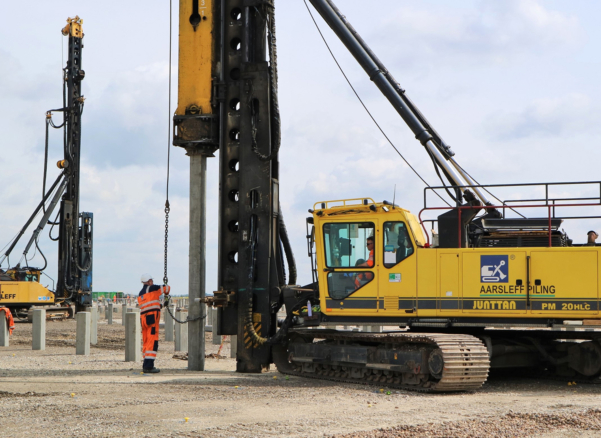
Within piling schemes, surrounding ground may continue to settle even where the structure has deeper support. This can affect adjoining slabs and services or apply downward drag to pile shafts, known as negative skin friction, so it should be considered alongside foundation movement.
Options for Limiting Predicted Settlement
Treatment follows the ground model and acceptable movement limits. Suitable near-surface fill may be excavated, replaced, or recompacted. Where deeper soils are compressible, preloading can allow some expected deformation to occur before permanent construction; vertical drains may accelerate consolidation under appropriate conditions.
Ground improvement provides further options. Rigid inclusions can reduce settlement through the combined behaviour of stiff columns, surrounding soil and a designed load-transfer arrangement.
Piled foundations may transfer structural loads to more suitable strata, although pile group settlement still requires assessment. Alternatively, foundation layout and structural detailing can help accommodate movement where preventing it would be impractical.
These approaches address different conditions. Selection must account for construction time, access and potential effects on neighbouring structures.
Monitoring Performance Through Construction
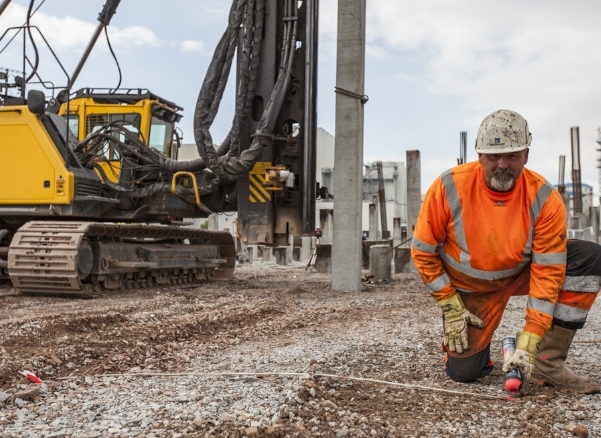
Settlement monitoring can use surveyed markers, plates or other instruments selected for the site. Baseline readings are established before the relevant loading stage, with measurement frequency matched to the expected rate of change.
Where monitoring informs construction decisions, review levels and response actions should be defined in advance. Results need interpretation alongside loading, groundwater conditions and the progress of the works.
The objective is not necessarily zero movement. It is to keep deformation within agreed limits and understand whether the ground is behaving as anticipated, providing a sound basis for subsequent construction.

Written by Aarsleff UK
22 October 2026
Aarsleff Ground Engineering is a leading sheet piling supplier and contractor. We specialise in designing and delivering sheet piling solutions across the UK.

Reviewed by Mark Fuller, Piling Director
7 October 2026
Mark Fuller is the Piling Director at Aarsleff Ground Engineering. He has amassed a wealth of experience and knowledge within the specialist piling and ground engineering industry throughout his 20 years of experience in the industry. Mark is directly responsible for the overall driven piling within the business, including technical and operational management of awarded contracts, development of strategic long-term plans and planning of recruitment and resource.
Close