Ground Beams
Table of Contents
- Ground Beams Within Construction
- Structural Roles Across Complex Sites
- Design Factors Influencing Performance
- Construction Methods And Site Delivery
- Integration With Foundations
- Durability Within Demanding Environments
- Ground Beams In Modern Development
Last updated
23 September 2026
Ground Beams Within Construction
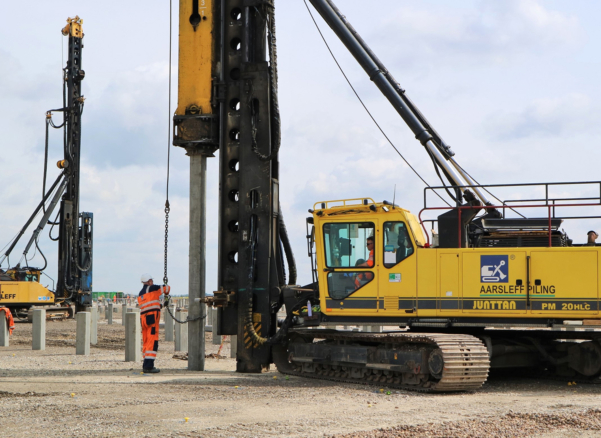
Ground beams form a critical link between foundations and the structural frame above. Positioned across piled or pad foundations, these reinforced elements distribute loads evenly while reducing pressure on weaker ground conditions. Across commercial, residential, and infrastructure developments, ground beams support stability where variable soils, underground services, or restricted excavation depths create engineering challenges.
Within wider ground engineering schemes, ground beams often work alongside piling systems, retaining walls, and reinforced foundations. Their role becomes particularly important on sites that require load transfer across unsupported spans or in areas affected by ground movement.
Careful structural coordination enables ground beams to enhance buildability, maintain alignment, and support long-term durability in demanding construction environments.
Structural Roles Across Complex Sites
Ground beams perform several functions depending on site requirements, structural design, and ground conditions. In many developments, they connect individual piles to create a continuous support system capable of handling substantial structural loads.
Projects involving commercial buildings, transport infrastructure, and industrial facilities frequently rely on ground beams where traditional strip foundations remain unsuitable. Weak strata, buried obstructions, waterlogged ground, or adjacent structures may all influence design selection.
Typical applications include:
- Linking piled foundations beneath commercial developments
- Supporting retaining walls near excavation zones
- Carrying structural loads across unstable ground
- Forming transfer beams around service corridors
- Assisting with foundation layouts on constrained urban sites
Where waterfront or coastal schemes are involved, ground beams may integrate with marine sheet piles or clearwater marine sheet piling systems to strengthen edge protection and support adjacent structures exposed to tidal or groundwater pressures.
Design Factors Influencing Performance
Several variables influence the design and specification of ground beams. Structural loading, soil composition, groundwater presence, and settlement tolerance all contribute to engineering decisions.
Engineers typically assess:
- Span requirements between foundation points
- Reinforcement detailing and concrete strength
- Interaction with piling layouts
- Construction sequencing and site access
- Long-term movement within the surrounding ground
Load distribution remains one of the most important considerations. Uneven settlement can place excessive stress on structural frames if beam sizing or reinforcement proves inadequate. Accurate geotechnical data, therefore, plays a central role during early-stage planning.
Ground beams may also accommodate complex interfaces with retaining walls, drainage systems, and below-ground utilities. On heavily constrained sites, coordination between structural and ground engineering teams often determines construction efficiency.
Construction Methods And Site Delivery
Installation methods vary depending on foundation type, excavation depth, and programme constraints. In many projects, piling operations take place first, followed by excavation between pile caps before reinforcement and shuttering installation begin.
Precast and in-situ solutions both appear across modern construction schemes. Precast systems can reduce site labour and accelerate programme delivery, particularly on repetitive commercial developments. In-situ ground beams, however, provide greater flexibility in irregular layouts or changing ground conditions.
Construction stages commonly include:
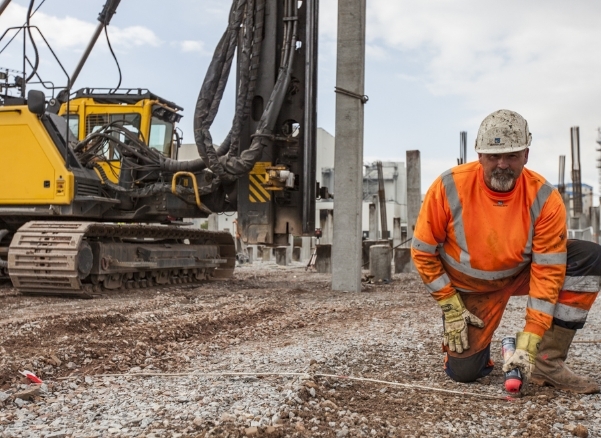
- Setting out foundation positions
- Completing piling or pad foundation works
- Excavating beam trenches
- Installing reinforcement cages
- Pouring and curing concrete
- Backfilling surrounding areas
Sequencing becomes especially important around infrastructure schemes where restricted access, live utilities, or phased construction programmes influence logistics and safety planning.
Integration With Foundations
Ground beams rarely operate in isolation. Most projects combine multiple structural and geotechnical elements to achieve stability across varying site conditions.
Piling systems frequently provide deep load transfer where near-surface soils lack bearing capacity. Ground beams then distribute those loads among the piles while supporting the walls, columns, and suspended floor slabs above.
On excavation support projects, retaining walls may work together with reinforced ground beams to resist lateral soil pressure. Coastal and flood defence developments sometimes combine marine sheet piles with reinforced beam structures to improve rigidity along quay walls, embankments, or dockside assets.
This integrated approach allows engineers to address structural performance, groundwater management, and construction practicality within a single coordinated solution.
Durability Within Demanding Environments
Exposure conditions strongly influence material selection and detailing requirements. Ground beams located near aggressive soils, fluctuating groundwater, or marine environments require additional protection measures to maintain long-term structural integrity.
Concrete specification, reinforcement cover, waterproofing systems, and drainage design all contribute to durability performance. Sulphate-resistant concrete may be used at chemically aggressive sites, while additional corrosion protection could be provided for structures near marine sheet piles or coastal infrastructure.
Movement joints, flexible connections, and accurate reinforcement placement also help reduce the risk of cracking associated with thermal movement or differential settlement.
Throughout commercial and infrastructure construction, maintaining durability standards supports operational lifespan while reducing future maintenance demands.
Ground Beams In Modern Development
Ground beams continue to play a major role across modern construction and civil engineering projects. Their ability to bridge weak ground, connect piling systems, and support structural loads makes them valuable across complex developments where conventional foundations face limitations.
From urban commercial schemes to transport infrastructure and waterfront construction, ground beams contribute to stable, coordinated foundation systems that adapt to varied site conditions. When combined with broader ground engineering techniques, retaining walls, piling operations, and clearwater marine sheet piling solutions, they remain an established component of contemporary structural design.


Written by Aarsleff UK
23 September 2026
Aarsleff Ground Engineering is a leading sheet piling supplier and contractor. We specialise in designing and delivering sheet piling solutions across the UK.

Reviewed by Mark Fuller, Piling Director
27 May 2026
Mark Fuller is the Piling Director at Aarsleff Ground Engineering. He has amassed a wealth of experience and knowledge within the specialist piling and ground engineering industry throughout his 20 years of experience in the industry. Mark is directly responsible for the overall driven piling within the business, including technical and operational management of awarded contracts, development of strategic long-term plans and planning of recruitment and resource.
Close