What is a CPT Test?
Table of Contents
- Understanding Cone Penetration Testing
- What Measurements Does a CPT Probe Record?
- Which Specialist Cones and Probes Are Used?
- How a CPT Sounding is Carried Out
- Interpreting the Ground Profile
- Where CPT Supports Construction Projects
- Ground Conditions That Limit the Test
- Turning Test Results into Design Decisions
Last updated
22 October 2026
Understanding Cone Penetration Testing
A cone penetration test (CPT) is a ground investigation technique in which an instrumented cone is pushed into the soil at a controlled rate. Sensors record resistance as the probe advances, producing a detailed profile of changes with depth.
The test examines in-situ ground behaviour. Unlike a sampling borehole, a standard CPT sounding does not recover material for visual inspection or laboratory testing. Engineers interpret its measurements alongside other ground investigation data.
What Measurements Does a CPT Probe Record?
A standard electrical cone records tip resistance and sleeve friction as it advances through the ground. A piezocone, used in CPTu testing, also measures pore-water pressure.
- Tip resistance (qc) is the force acting on the cone tip divided by its projected area. Changes in this reading help engineers assess soil strength and density through the profile.
- Sleeve friction (fs) measures resistance along the sleeve behind the tip, expressed per unit surface area. Interpreted alongside tip resistance, it helps distinguish the behaviour of different soil layers.
- Pore-water pressure (u) records water pressure within the soil pores during penetration. Measurements taken while pushing and during pauses provide information about the ground’s drainage response.
Which Specialist Cones and Probes Are Used?
Additional sensors and alternative probe shapes let investigations explore soil stiffness, groundwater movement, and environmental conditions. Equipment is selected according to the information needed:
- Seismic cones: receivers detect waves generated at the surface. Their travel times allow calculation of wave velocities, supporting assessments of soil stiffness at small strains.
- Video cones: a miniature camera captures close-up views of surrounding material, helping identify soil features and visible evidence of certain contaminants.
- Resistivity cones: electrical sensors measure how strongly the ground resists electrical current. Variations support investigations into soil composition, groundwater salinity and potential contamination.
- Soil moisture cones: sensors record electrical properties associated with water content, allowing engineers to estimate moisture variations through the ground.
- Ball and T-bar penetrometers: spherical or horizontal bar-shaped attachments replace the conical tip. Resistance as soft soil flows around them helps engineers assess undrained shear strength.
- Gamma cones: sensors detect natural gamma radiation to help distinguish geological materials, including clay infill within dissolution features in chalk.
- Hydraulic profiling tools: water is injected into the soil while pressure and flow are recorded. The results indicate how readily water moves through different layers and support estimates of hydraulic conductivity.
How a CPT Sounding is Carried Out
The investigation plan establishes test positions, target depths and any additional measurements required. A typical sounding follows this sequence:
- Prepare the test location. Check access, working conditions and buried services before positioning suitable equipment.
- Set up and check the instruments. Verify the cone’s condition and sensor readings. For CPTu testing, the pore-pressure measurement system is also prepared and checked.
- Set up and check the instruments. Verify the cone’s condition and sensor readings. For CPTu, prepare the pore-pressure measurement system appropriately.
- Advance the probe. Hydraulic equipment pushes the cone into the ground at a controlled rate, normally around 20 mm per second, while measurements are recorded.
- Undertake planned pauses. Where specified, dissipation tests monitor changes in pore pressure while penetration stops.
- Withdraw and complete the location. Recover the equipment, perform the required instrument checks and seal or reinstate the penetration hole as specified.
Testing ends at the planned depth or when an appropriate stopping criterion is met. Equipment capacity, excessive inclination or an obstruction may prevent further penetration.
Interpreting the Ground Profile
Changes in cone resistance, sleeve friction, and pore pressure help identify layer boundaries and differences in soil behaviour. Interpretation charts can indicate whether the response resembles sand, silt, or clay.
CPT interpretation provides a soil behaviour classification rather than a direct identification of soil type, so it does not replace physical sampling and laboratory testing. Unusual geology, cementation or mixed deposits can complicate interpretation.
This is a soil behaviour classification, not a substitute for sample testing. Unusual geology, cementation or mixed deposits can complicate interpretation.
Using appropriate correlations, engineers can estimate properties relevant to strength, density and compressibility. CPTu dissipation results can also inform assessment of drainage and consolidation behaviour.
Confidence improves when these interpretations are checked against borehole records, laboratory tests and geological information. Differences between datasets may indicate a need for further investigation.
Where CPT Supports Construction Projects
Residential, commercial and institutional developments use CPT data to assess foundation options and identify compressible layers beneath buildings or floor slabs. Infrastructure and rail investigations can apply it to embankments, bridge approaches and route corridors.
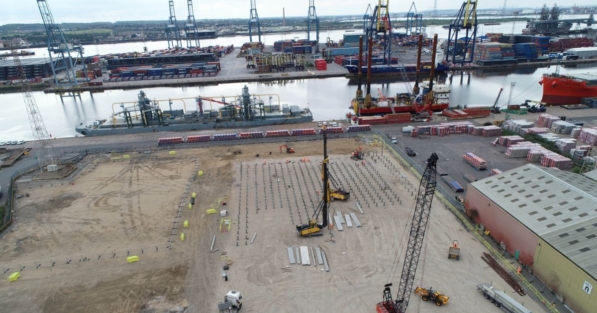
Marine work may use seabed or over-water testing arrangements to investigate ports and offshore structures. Energy applications include wind farm foundations, substations and cable routes, with equipment selected for the environment.
Within ground engineering, results can inform piling design, retaining wall assessments and ground improvement schemes. Comparisons before and after treatment may also contribute to verification where the specification defines an appropriate approach.
Ground Conditions That Limit the Test
CPT is particularly useful in penetrable soils where closely spaced readings can reveal variations that intermittent sampling might miss. However, gravel, cobbles, hard cemented layers and rock can obstruct or damage the probe.
CPT refusal does not automatically indicate that a continuous bearing stratum has been reached. A local boulder or buried obstruction may produce a similar response, requiring investigation by another method. CPT refusal relates to the inability to advance the test probe and should not be confused with pile refusal during piling operations.
Achievable depth also depends on available reaction force, rod friction and equipment limits. Downhole testing or pre-drilling may extend an investigation through difficult layers, but the resulting gaps and changes in procedure must be documented.
Turning Test Results into Design Decisions
A CPT profile represents conditions along one penetration path. Test locations must therefore provide suitable coverage of the proposed works, particularly where loads or geology vary across the site.
Design interpretation should distinguish measured values from estimated parameters and explain the assumptions behind them. The highest cone resistance alone does not establish the best founding level, nor does a single sounding demonstrate uniform conditions.
Combined with complementary investigation, CPT provides a detailed basis for understanding the ground. Its value lies in connecting that evidence to the foundation, earthworks or treatment decisions the project needs to make.

Written by Aarsleff UK
22 October 2026
Aarsleff Ground Engineering is a leading sheet piling supplier and contractor. We specialise in designing and delivering sheet piling solutions across the UK.

Reviewed by Mark Fuller, Piling Director
7 October 2026
Mark Fuller is the Piling Director at Aarsleff Ground Engineering. He has amassed a wealth of experience and knowledge within the specialist piling and ground engineering industry throughout his 20 years of experience in the industry. Mark is directly responsible for the overall driven piling within the business, including technical and operational management of awarded contracts, development of strategic long-term plans and planning of recruitment and resource.
Close