What Is CFA Piling?
About Continuous Flight Auger Piling
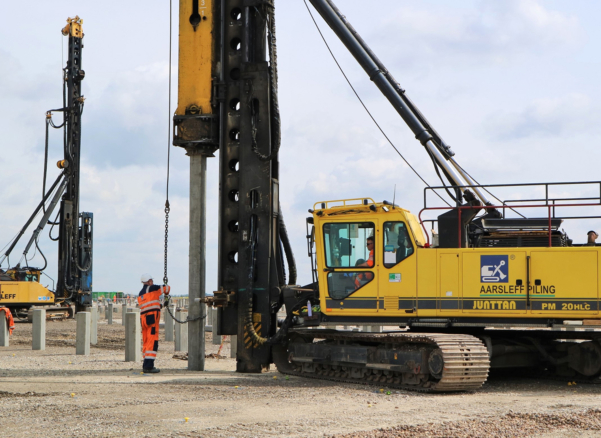
Continuous flight auger (CFA) piling or auger piling is a common, in-situ foundation method, used in the UK since the 1960s. Due to its low level of vibration and noise, this method of piling is particularly suited for soft or water-bearing strata where casings or bentonite would otherwise be necessary. [1]
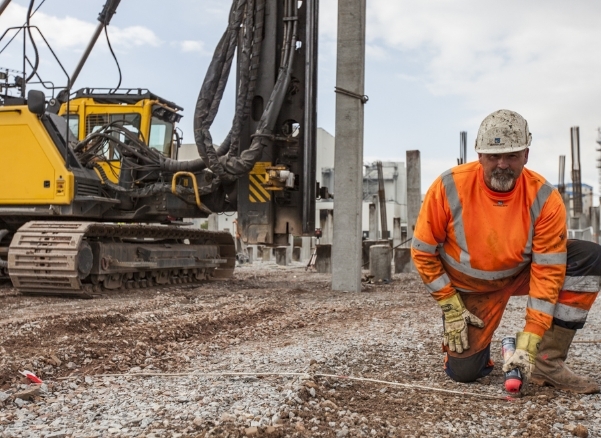
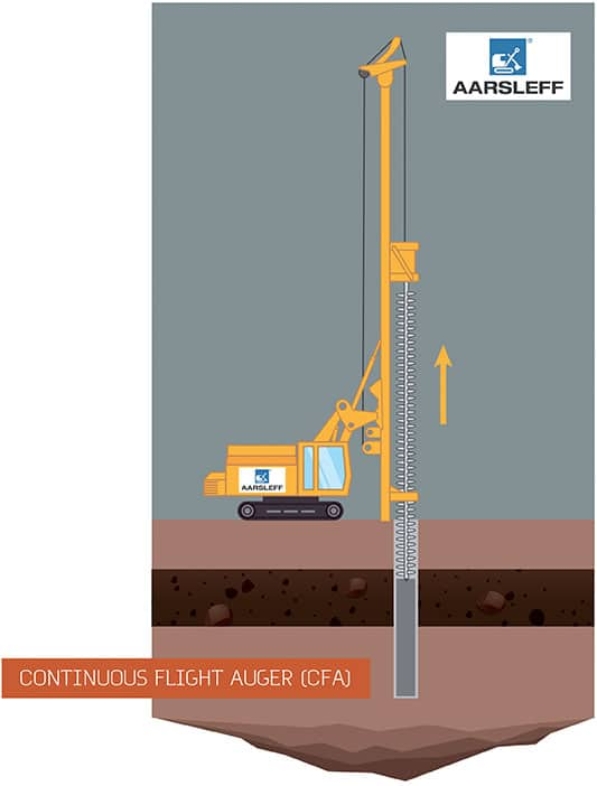
It involves the use of a CFA piling rig to drill a contiguous flight auger into the ground. The auger holds the soil surrounding the hole, eliminating the need for temporary casings and support fluids. Continuous flight auger piling is often known as one of the quietest piling methods available, making it an ideal solution for projects in urban locations and environmentally sensitive areas.
What Are CFA Piles?
When the installation process is completed, it leaves behind a column of concrete, creating a continuous CFA pile. It is also referred to as auger piles. These piles can be achieved with depths up to 35m and in various dimensions between 300mm and 1200mm based on the soil conditions. [2] This means that CFA piles are effective for low to mid-range loading.
Common Uses
Most common uses of CFA piling include:
- Support buildings, bridges, and other structures
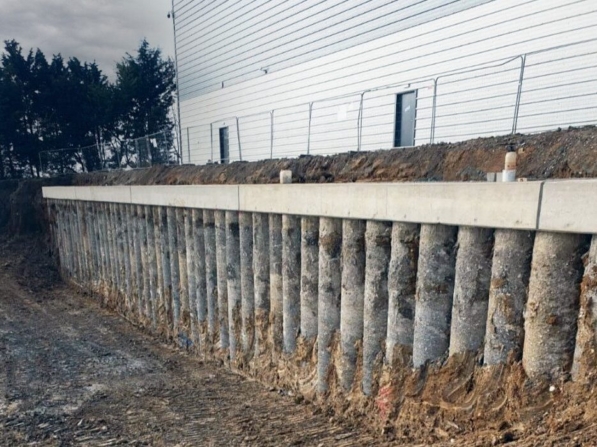
- Used as retaining walls and secant/tangent pile walls for deep basements
- Stabilise slopes to prevent soil movement and landslides
- Provide flood prevention
- Suitable for working close to existing buildings or in built-up areas where minimal disruption is critical
- Can be used in conjunction with Ground Anchors and in the installation of Contiguous Pile Walls or Secant Pile Walls
How Are CFA Piles Constructed?
CFA piles are constructed using the following general steps:
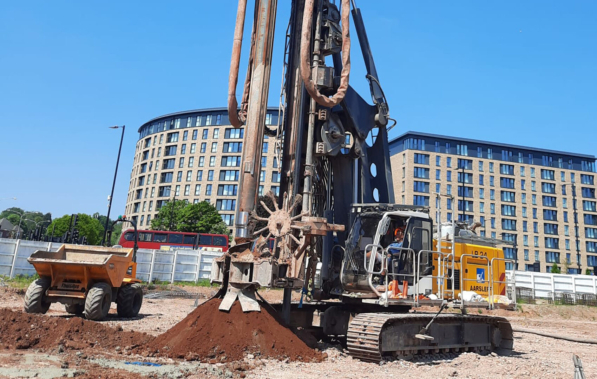
- A hollow stem continuous flight auger is drilled and rotated into the ground to the required depth.
- Once the desired depth has been met, the wet concrete mix is pumped through the hollow stem with static head pressure
- The spoil is removed by an excavator as the auger is slowly extracted from the ground.
- After the concrete is added and extends to ground level, a steel reinforcement cage is inserted through the freshly placed concrete to enhance its structural capacity. Cages are usually inserted by an excavator or a cage-vibrator for longer cages.
- After the pile has been constructed, the ground around the top of the pile is cleared and prepared for further construction activities.
- Rigorous testing is carried out to monitor and manage the structural integrity and load capacity of the pile.
Throughout the pile construction process, CFA rigs fitted with state-of-the-art instrumentation provide rig operators with feedback based on the key parameters such as auger depth, casing depth, drill pressure/auger torque, and penetration speed during the drilling phase. This enables piling contractors with continuous operation monitoring and real-time quality control.
How Much Does CFA Piling Cost?
CFA piles cost varies widely from project to project, typically a couple of hundred pounds per linear metre. The cost reflects the high productivity for projects where large numbers of piles are required. Ground conditions, pile depth and diameter, site accessibility, material and labour costs are some factors that can influence CFA pile cost.
What Is the Difference Between CFA Piles and Bored Piles?
CFA and bored piles are both installed using augers and both involve cast in-situ concrete. When installing bored piles, the auger is removed once the channel has been dug, with the reinforcement added prior to the concrete pour. Bored piles are larger in diameter than augered piles, and are often used for larger loads and greater depths. CFA piling is much faster to install, due to the auguring and concreting being part of the same motion.

How Many CFA Piles Can Be Installed per Day?
For private projects installing CFA piles with a diameter of 300 to 450mm and under 20m in length, around 300 to 450m can be installed per day. These rates are achievable on private projects, such as large buildings, where most of the piles are relatively close together, reducing the rig’s movement between piles.
Lower production rates, such as 60 to 150m (200 to 500 ft) per day, should be expected for transportation projects where pile groups supporting bridge bents are spread across a large project area.
Advantages
The advantages of CFA piling include:
- High production rates mean that piles are commercially attractive
- Quietest forms of piling, as minimal noise levels are produced during installation
- Virtually vibration-free
- Cost-effective and versatile method
- Suitable for most ground conditions and construction projects including gravels, sands and clays
- There is no requirement for a casing when piling, reducing both cost and time
- Fully monitored pile production
- Quick and economical solution
- Can be constructed in close proximity to buildings and other structures
Sources
- Designing Buildings. (20222). Continuous Flight Auger Piles. Retrieved 6th January 2025, from:
https://www.designingbuildings.co.uk/wiki/Continuous_flight_auger_piles - The Constructor. (n.d). Continuous Flight Auger Piles: Constructions and Applications. Retrieved 6th January 2025, from:
https://theconstructor.org/geotechnical/continuous-flight-auger-piles/9123/

Written by Aarsleff UK
23 September 2025
Aarsleff Ground Engineering is a leading sheet piling supplier and contractor. We specialise in designing and delivering sheet piling solutions across the UK.

Reviewed by Mark Fuller, Piling Director
14 January 2025
Mark Fuller is the Piling Director at Aarsleff Ground Engineering. He has amassed a wealth of experience and knowledge within the specialist piling and ground engineering industry throughout his 20 years of experience in the industry. Mark is directly responsible for the overall driven piling within the business, including technical and operational management of awarded contracts, development of strategic long-term plans and planning of recruitment and resource.
Close