Table of Contents
- About Pile Cages
- Where Are Pile Cages Commonly Used?
- How Reinforcement Works Within a Pile
- How Are Pile Cages Made and Installed?
- What Determines Cage Length and Diameter?
- Why Cover and Pile Head Details Matter
Last updated
22 October 2026
About Pile Cages
Pile cages are steel reinforcement frameworks embedded within concrete piles. They consist of bars running along the pile, held together by circular links, a continuous spiral or other shaped reinforcement.
Once surrounded by hardened concrete, the cage becomes part of a reinforced structural element. Its arrangement depends on the forces the pile must resist and the construction method used. Cages feature in bored and CFA piling, as well as in the manufacture of reinforced precast concrete piles.
Where Are Pile Cages Commonly Used?
Pile cages are used in deep foundations and piled retaining walls across many ground engineering projects. Typical applications include:
- Infrastructure: reinforced foundations beneath bridges, road structures and utility installations.
- Marine: concrete piles supporting jetties, quay structures and port developments.
- Residential: foundations for housing and apartment buildings, including basement retaining structures.
- Institutional & Cultural: piled support beneath schools, hospitals and university facilities.
- Commercial: foundations for warehouses, offices and retail developments.
- Rail: reinforcement within piles for station buildings, bridge supports and depot structures.
- Energy: foundations beneath substations, generating facilities and wind turbine structures.
Cages also reinforce individual piles within contiguous pile walls and the structural piles in certain secant wall arrangements. These retaining systems resist pressure from surrounding ground during excavation and, where designed to do so, throughout the completed structure’s life.
How Reinforcement Works Within a Pile
Concrete is highly effective at carrying compressive loads but has limited tensile strength. Steel reinforcement within a pile helps it resist tension and bending, including forces caused by uplift and lateral loads.
A pile reinforcement cage typically consists of longitudinal steel bars supported by transverse links or spirals. The longitudinal bars provide the main reinforcement, while the links or spirals provide shear resistance and help confine the concrete. The bond between the steel reinforcement and concrete allows the two materials to work together.
The reinforcement cage alone does not determine the load-bearing capacity of a pile. The pile’s dimensions, design and interaction with the surrounding soil or rock also influence how much load the foundation can safely carry.
How Are Pile Cages Made and Installed?
Cages may be prefabricated in a specialist facility or assembled on site. Fabrication follows reinforcement drawings that specify bar sizes, spacing, connections and overall dimensions. Installation then follows:
- Assembly and inspection: bars are secured using specified ties or welds. Completed cages are checked against the reinforcement drawings, including any lifting details and additional stiffening.
- Handling and preparation: suitable lifting equipment for the cage’s weight and shape is selected. Spacers are fitted to maintain the required concrete cover.
- Positioning: for rotary bored piles, reinforcement is normally lowered into the prepared bore before concreting. With CFA piles, it is inserted into fresh concrete after the auger has been withdrawn.
- Joining sections: where delivery restrictions, headroom or cage length prevent installation in one piece, sections are connected using designed laps, couplers or other specified arrangements.
- Final checks: the installed level and position are verified, with support provided to prevent unwanted movement during subsequent work.
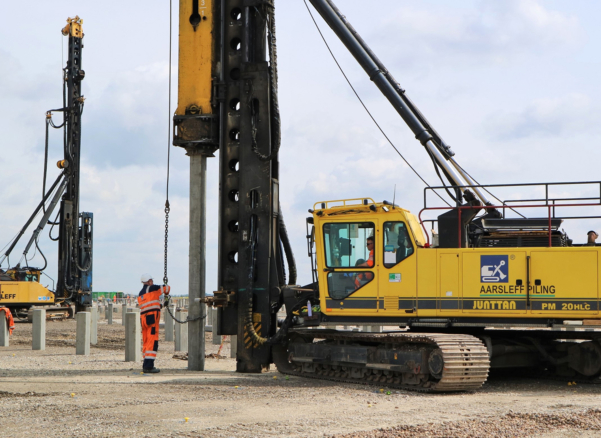
For driven precast concrete piling, this sequence differs: reinforcement is positioned in a mould and encased in concrete during factory production. The completed pile arrives on site ready to be driven.
What Determines Cage Length and Diameter?
Cage dimensions follow structural requirements, construction constraints and the pile’s geometry. Bar spacing must allow concrete to flow around the steel without leaving voids.
Full-length reinforcement is not necessary for every cast-in-place pile. Some designs require a cage only within the upper shaft; others need steel extending much deeper to accommodate the calculated forces and anchorage requirements.
Transport restrictions and available lifting height can influence how many sections are supplied. For CFA installation, concrete workability and reinforcement congestion also affect whether the cage can reach its specified depth.
Why Cover and Pile Head Details Matter
Concrete cover is the distance between the outermost steel reinforcement and the surface of the pile. This layer of concrete helps protect the reinforcement from corrosion while providing the bond needed between the steel and concrete. Spacers are used to maintain the correct concrete cover when the reinforcement cage is positioned within the pile.
At the pile head, reinforcement bars may extend beyond the pile to connect it to a pile cap or capping beam. The length and position of these projecting bars must be considered as part of the connection design, including any concrete that will be removed when the pile is trimmed to its final cut-off level.
Careful consideration of these details helps ensure the pile reinforcement is correctly positioned and can form the required connection with the structure above.

Written by Aarsleff UK
22 October 2026
Aarsleff Ground Engineering is a leading sheet piling supplier and contractor. We specialise in designing and delivering sheet piling solutions across the UK.

Reviewed by Mark Fuller, Piling Director
6 October 2026
Mark Fuller is the Piling Director at Aarsleff Ground Engineering. He has amassed a wealth of experience and knowledge within the specialist piling and ground engineering industry throughout his 20 years of experience in the industry. Mark is directly responsible for the overall driven piling within the business, including technical and operational management of awarded contracts, development of strategic long-term plans and planning of recruitment and resource.
Close