What is a Slurry Wall?
Table of Contents
- About Slurry Walls
- Types of Slurry Walls
- How Are Slurry Walls Constructed?
- What Is the Difference Between a Slurry Wall and a Diaphragm Wall?
- How Much Does a Slurry Wall Cost?
- Advantages of Slurry Walls
Last updated
23 September 2025
About Slurry Walls
A slurry wall, also known as a slurry cut-off wall, is a type of ground engineering technique. It is primarily used to provide an underground low-permeability barrier, preventing the flow of groundwater and other contaminants. [1]
The slurry wall technique was founded in the 1950s by an Italian company called ICOS during the evacuation of the Red Line of the Milan Metro. Over the decades, slurry wall construction has been demonstrated in many well-known engineering projects such as the World Trade Center in New York City. [2]
Types of Slurry Walls
There are two common types of slurry walls, each designed for specific applications:
- Cement-Bentonite Slurry Wall – involves adding cement to the bentonite and water mix, which sets into a hardened, impermeable barrier. The cement-bentonite slurry wall is an excellent choice for environments requiring sturdy structural support and exceptional impermeability. These walls are suitable for use in foundations, dams and other applications.
- Soil-Bentonite Slurry Walls – This type uses soil excavated from the site and mixed with bentonite. This type is cost-effective and widely utilised for groundwater control and environmental containment barriers. It combines the physical properties of the surrounding earth with the sealing capabilities of bentonite.
How Are Slurry Walls Constructed?
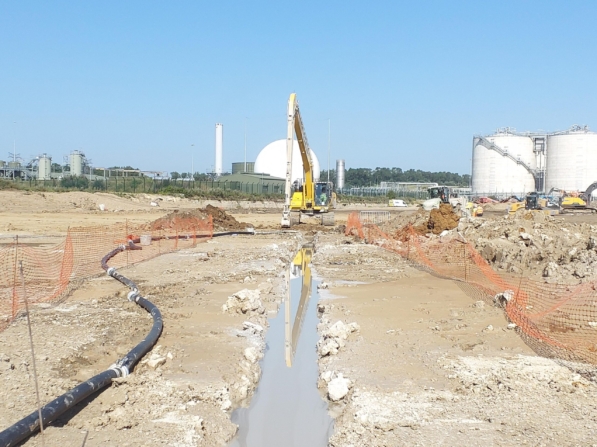
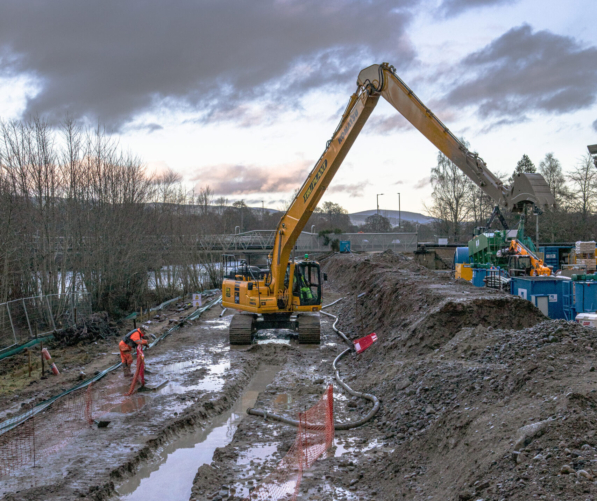
Aarsleff’s single-phase, self-hardening slurry trench cut-off walls are constructed by excavating a trench under a cement-bentonite slurry. The slurry remains fluid during excavation, and in this state allows the formation of a filter cake of bentonite on the side walls enabling the hydrostatic pressure of the slurry to prevent the collapse of the trench.
Due to the cementitious content, the slurry hardens within about 24 hours to form the low permeability barrier. The hardened slurry has a low permeability, typically 1×10⁻⁸ to 1×10⁻¹⁰ m/s and the strength properties of a stiff clay but it does not possess the plastic properties of clay.
Most slurry trench cut-off walls built in the UK are 0.6 m wide. The practical maximum width is 1.5 m, although a more than 1.0 m width is unusual. Trenches can be excavated to about 12-15m deep in most ground conditions using hydraulic back-actors (backhoes). For depths below this and in particularly difficult ground conditions, diaphragm wall grabs or cutters are used. Slurry walls are normally keyed into an aquiclude, an underlying layer of low-permeability material.
What Is the Difference Between a Slurry Wall and a Diaphragm Wall?
Slurry walls are also referred to as diaphragm walls. A diaphragm wall is a reinforced concrete structure cast into the ground to support deep excavation work in basements, tunnel approaches, rail stations, pumping stations and underground car parks. [3]
While slurry walls and diaphragm walls can be used as a groundwater barrier, they have many differences. Diaphragm walls are generally thicker and excavated at depths deeper than slurry walls. For projects that require a supportive and long-lasting structure, diaphragm walls are often used, whereas slurry walls are more suitable as temporary groundwater barriers.
How Much Does a Slurry Wall Cost?
The cost of a slurry wall can vary from project to project. It can depend on a variety of factors:
1. Wall Dimensions
Deeper and thicker walls such as diaphragm walls require more materials and specialised equipment, which can increase costs.
2. Ground Conditions
Sites with complex or challenging ground conditions such as high groundwater levels require specialised techniques or additional testing, raising slurry wall costs.
3. Materials
The type of materials used to build the slurry wall can influence the overall cost. While cement and bentonite or ready-to-mix blends are reasonably priced, higher-quality materials can drive costs. Soil-bentonite slurry walls are generally more cost-effective than cement-bentonite slurry walls as the soil excavated on-site is used instead of cement.

Advantages of Slurry Walls
Aside from having very low permeability, slurry walls provide other advantages to sites including:
- Can be installed quickly with minimal noise and vibration.
- A cost-effective solution compared to other methods.
- Have excellent resistance to heavy metals and contaminated materials such as tars, solvents, VOCs (volatile organic compounds), hydrocarbons and fuel.
- The use of high replacement CEMIII cementitious materials in the cement bentonite slurry mix design not only significantly reduces the carbon footprint of the mix but also reduces the permeability of the cured material when compared to OPC.
Sources
- Wikipedia. (2023). Slurry Wall. Retrieved 2nd December 2024, from:
https://en.wikipedia.org/wiki/Slurry_wall - 9/11 Memorial (n.d.) Slurry Wall: Behind the Engineering Feat That Made the WTC Possible. Retrieved 2nd December 2024, from:
https://www.911memorial.org/connect/blog/slurry-wall-behind-engineering-feat-made-wtc-possible - Design Buildings. (2021). Diaphragm Wall. Retrieved 2nd December 2024, from:
https://www.designingbuildings.co.uk/wiki/Diaphragm_wall

Written by Aarsleff UK
23 September 2025
Aarsleff Ground Engineering is a leading sheet piling supplier and contractor. We specialise in designing and delivering sheet piling solutions across the UK.

Reviewed by Andrew Waghorn, Ground Engineering Director
2 December 2024
Andrew Waghorn is the Ground Engineering Director at Aarsleff. He is a Chartered Civil Engineer, Chartered Manager and Registered Geotechnical Engineering Professional (RoGEP) with experience gained over 20 years within the UK, Irish and Australian piling industries covering predominantly CFA, Rotary Bored and Driven piling techniques. Andrew operated in estimating, design and operational roles with the past 10 years at Director level.
Close