Table of Contents
- How Does Piling Work?
- The Origins of Pile Foundations
- What are Piles Made From?
- Soil Mechanics
- Types of Piles
- Why Would a Site Need Piling?
- Advantages of Pile Foundations
Last updated
18 July 2025
How Does Piling Work?
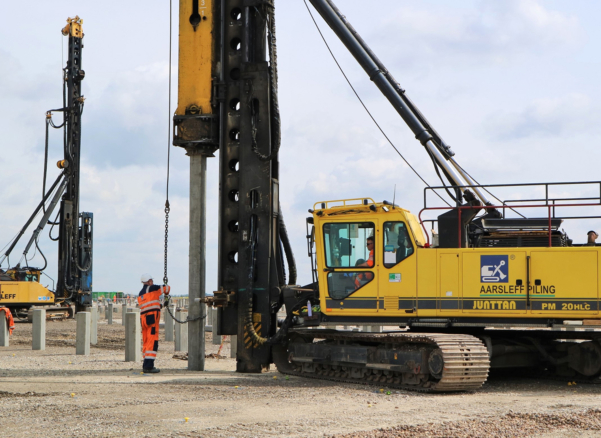
One of the most well-known construction and geotechnical techniques, piling is the process of driving or boring long, slender columns (known as piles) deep into the ground using a piling rig to form a deep foundation for buildings, bridges or other structures.
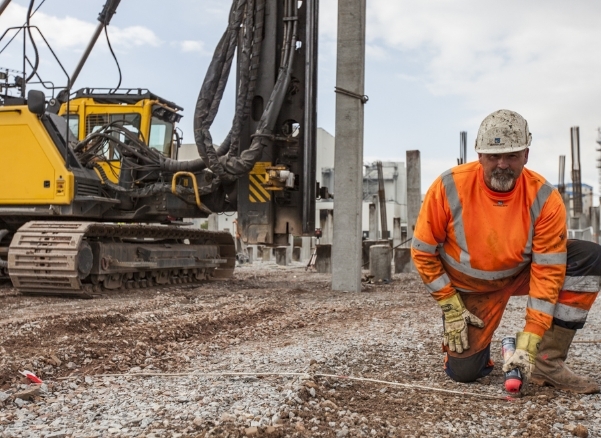
Essentially, this means that piles are generally used when the bearing capacity of the surrounding soil is considered to be weak in structure due to the ground conditions or inadequate for the structural load of heavy construction. Pile foundations are installed by geotechnical engineers and piling specialists along a certain area to carry and transfer the load to the solid ground located at a depth.
The Origins of Pile Foundations
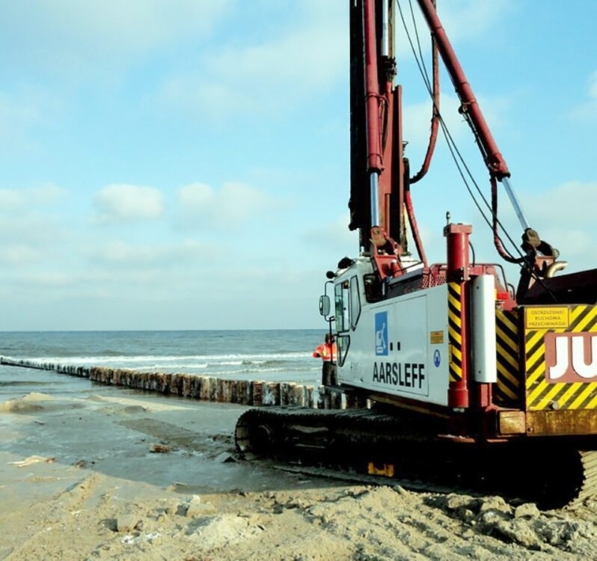
Piling techniques are not a recent development in the construction industry, they have been around for centuries! The history of constructing buildings using piles dates back to the 4th century BC, when people used piles for constructing foundations on poor soils near rivers. Many villages and towns were located in the close vicinity of lakes and rivers due to the availability of water, and, also, to ensure proper protection of the area. Therefore, the weak bearing ground was reinforced by the use of timber piles that were either driven into the ground by hand or fixed in holes that were filled with stones and sand. [1]
In Britain, there are numerous examples of the Romans using wooden piles in construction. In mediaeval times, piles of oak and alder were used in the foundations of the great monasteries constructed in the fenlands of East Anglia. Timber, because of its strength combined with lightness, durability and ease of cutting and handling, remained the only material used for piling until comparatively recent times.
Nowadays, piles are often used in construction for everything, from residential houses to huge industrial warehouses and off-shore wind farms.
Nowadays, piling has been used in the foundations for everything, from residential houses to huge industrial warehouses and off-shore wind farms.
What are Piles Made From?
Piles are mostly made of steel but also timber, in-situ and precast concrete, each possessing different characteristics. As technology evolved, wood was replaced by steel or concrete only because these newer materials could be fabricated into units that were capable of sustaining compressive, bending and tensile forces far beyond the capacity of a timber pile of like dimensions.
Concrete piles, in particular, were adaptable to in-situ forms of construction which facilitated the installation of piled foundations in drilled holes in situations where noise, vibration and ground heave had to be avoided. Reinforced concrete, which was developed as a structural medium in the late nineteenth century and early twentieth centuries, largely replaced timber for high-capacity piling for works on land. It could be precast in various structural forms to suit the imposed loading and ground conditions, and its durability was satisfactory for most soil and immersion conditions.
Steel piles have been used to an increasing extent for piling due to their ease of fabrication and handling and their ability to withstand hard driving. Problems of corrosion in marine structures have been overcome by the introduction of durable coatings and cathodic protection.
Soil Mechanics
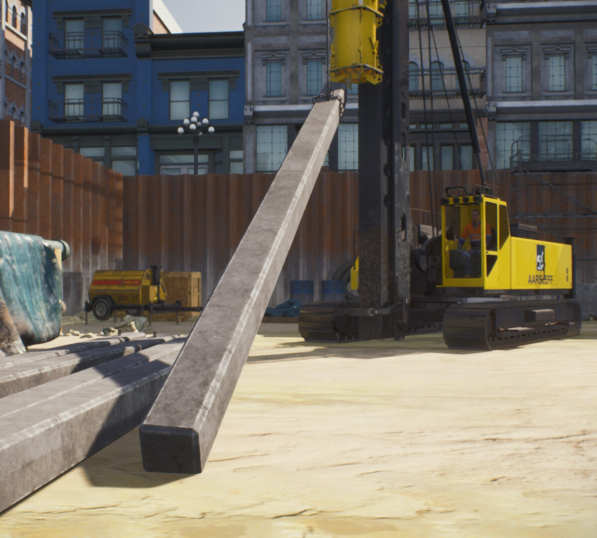
While pile materials can be precisely specified, the calculation of their load-carrying capacity is a complex matter which at the present time is based partly on theoretical concepts derived from the sciences of soil and rock mechanics, but mainly on empirical methods based on experience. Practising the calculation of the ultimate carrying capacity of piles based on the principles of soil mechanics differs greatly from the application of these principles to shallow spread foundations.
In the latter case, the entire area of soil around the pile is exposed and can be inspected and sampled to ensure that its bearing characteristics conform to those deduced from the results of exploratory boreholes and soil tests.
Types of Piles
As mentioned earlier, piles are primarily made from wood, concrete and steel. There is a wide range of pile types used for different soil conditions, load requirements, the space available and environmental factors. [2]
Piles can be classified into the following categories: large displacement piles (driven types), large displacement piles (driven and cast-in-place types), small displacement piles and replacement piles: [3]
Large Displacement Piles (Driven Types):
- Timber (round or square section, jointed or continuous)
- Precast concrete (solid or tubular section in continuous or jointed units)
- Prestressed concrete (solid or tubular section)
- Steel sheet piles
- Steel tube (driven with closed end)
- Steel box (driven with closed end)
- Fluted and tapered steel tube
- Jacked-down steel tube with closed end
- Jacked-down solid concrete cylinder
Large Displacement Piles (Driven and Cast-in-Place Types):
- Steel tube driven and withdrawn after placing concrete
- Precast concrete shell filled with concrete
- Thin-walled steel shell driven by withdrawable mandrel and then filled with concrete
Small Displacement Piles:
- Precast concrete (tubular section driven with open end)
- Prestressed concrete (tubular section driven with open end)
- Steel H-piles
- Steel tube section (driven with open end and soil removed as required)
- Steel box section (driven with open end and soil removed as required)
Replacement Piles:
- Concrete placed in a hole drilled by a rotary auger, baling, grabbing, airlift or reverse-circulation methods (bored and cast in-place)
- Tubes placed in hole drilled as above and filled with concrete as necessary
- Precast concrete units placed in drilled hole
- Cement mortar or concrete injected into a drilled hole
- Steel sections placed in a drilled hole
- Steel tube drilled down
- Continuous flight auger (CFA) piles
Why Would a Site Need Piling?
A traditional shallow foundation is enough when the ground is suitable and the load it has to support is moderate, but there are many ways for the ground to be unsuitable, so piling is strongly advised on a site if:
- The water table is high
- The soil is of a type whose stability will be affected by water
- Deep trench foundations from a previous building would be too expensive to remove
- Existing foundation trenches are unstable
- The ground is unsuitable for more than two metres
- The nature of the load requires support

Advantages of Pile Foundations
Piling is a cornerstone of building deep foundations. They provide many on-site advantages including:
- It helps to support structures and prevent settlement by transferring the load of the building to a stronger, more stable layer of soil or rock.
- Piling methods increase the load-bearing capacity of the soil, allowing for taller and heavier structures to be built.
- Suitable for the majority of soil types and conditions, making it ideal for pile construction projects.
- Pile foundation solutions can be installed quickly, allowing for faster construction times and reduced project durations.
- In many cases, piling can be a cost-effective solution for building on challenging or unstable ground, as it eliminates the need for extensive earthworks or foundations.
- Properly installed piles can provide a long-lasting foundation for buildings and infrastructure, minimising the need for maintenance and repairs
- Piling can minimise disruption to the surrounding environment by reducing the need for extensive excavation and earthworks.
Sources
- 1. Project Gutenberg. (2013). The History Of Herodotus, by Herodotus. Retrieved 3rd September 2025, from:
https://www.gutenberg.org/files/2707/2707-h/2707-h.htm - 2. Designing Buildings. (2022). Types of Pile Foundation. Retrieved 3rg September 2024, from:
https://www.designingbuildings.co.uk/wiki/Types_of_pile_foundation - 3. British Standards Institution. (2020). BS 8004 - Code of Practice for Foundations. Retrieved 3rd September 2024, from:
https://knowledge.bsigroup.com/products/code-of-practice-for-foundations-2?version=standard

Written by Aarsleff UK
18 July 2025
Aarsleff Ground Engineering is a leading sheet piling supplier and contractor. We specialise in designing and delivering sheet piling solutions across the UK.

Reviewed by Mark Fuller, Piling Director
30 September 2024
Mark Fuller is the Piling Director at Aarsleff Ground Engineering. He has amassed a wealth of experience and knowledge within the specialist piling and ground engineering industry throughout his 20 years of experience in the industry. Mark is directly responsible for the overall driven piling within the business, including technical and operational management of awarded contracts, development of strategic long-term plans and planning of recruitment and resource.
Close