Stone Piling and Its Purpose
What is Stone Piling?
Stone piling is a ground improvement technique in which compacted aggregate is installed in the ground to enhance its load-bearing capacity. Rather than forming a structural pile in the traditional sense, a stone pile reinforces weak soils by increasing density and improving drainage.
This approach replaces or displaces softer material with compacted stone, creating columns that work with the surrounding ground. The result is a more stable base capable of supporting structures without relying on deep foundation systems.
Stone piling is often selected where soil conditions limit the effectiveness of conventional foundations, offering a practical alternative that avoids extensive excavation.
Where is Stone Piling Commonly Applied?
Stone piling is used across a range of construction sectors where ground conditions require improvement rather than full replacement. Typical applications include:
- Commercial developments – Supporting slabs and shallow foundations where uniform ground performance is needed.
- Infrastructure projects – Used beneath embankments and roadways to improve stability and reduce settlement.
- Residential schemes – Providing a reinforced base for housing built on softer soils.
- Industrial sites – Enhancing ground conditions for storage areas, yards, and lightly loaded structures.
- Ground remediation works – Addressing poor soil quality in previously developed or filled sites.
This variety highlights how a stone pile can be adapted to suit different project demands.
How Stone Piling is Installed
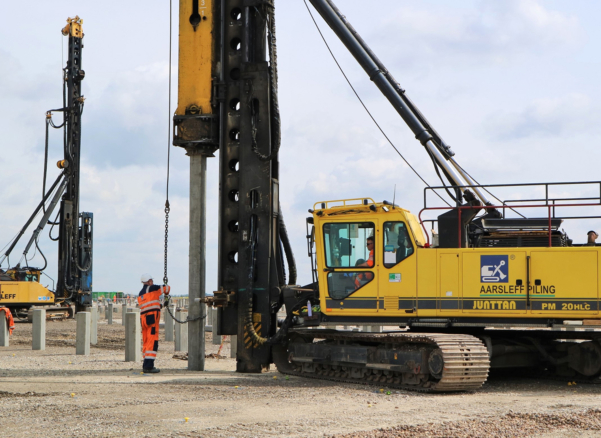
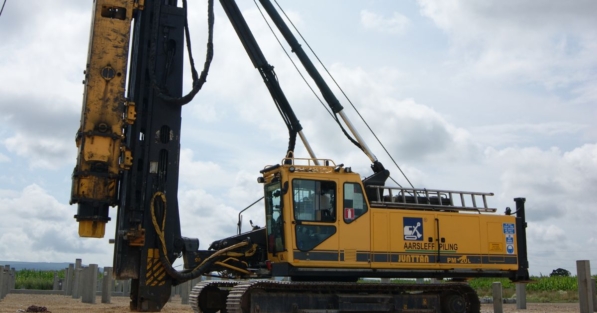
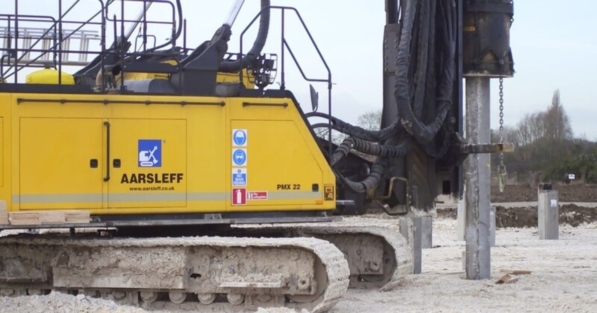
- Installation begins with specialist equipment that penetrates the ground using vibration or displacement techniques. A cavity is formed, either by pushing soil aside or temporarily loosening it.
- Once the required depth has been reached, graded aggregate is introduced. The material is then compacted in stages, forming a dense column. This process creates a stone pile that interacts with the surrounding soil, improving overall stiffness.
- Load from the structure above transfers through both the stone columns and the improved ground between them. This combined behaviour reduces settlement and increases bearing capacity.
Methods Used to Form Stone Columns
Several techniques are used within stone piling, depending on site conditions and project requirements:
- Top feed installation – Aggregate is added from the surface and compacted in layers as the installation tool is raised and lowered.
- Bottom-feed installation – Stone is delivered directly to the base via a feed pipe, allowing placement in unstable or waterlogged soils.
- Displacement methods – Soil is pushed outward rather than removed, maintaining ground continuity while forming the column.
Each method produces a stone pile suited to specific ground conditions, ensuring performance aligns with design expectations.
Materials Used in Stone Piling Works
Stone piling relies on carefully selected aggregate to achieve the desired performance. Crushed stone or gravel is commonly used due to its strength and drainage properties.
The material’s grading plays a key role. Well-graded aggregate compacts effectively, forming a stable column that resists deformation under load. This contributes to the long-term performance of each stone pile.
Unlike concrete-based systems, stone piling uses natural materials that can often be sourced locally, depending on project requirements.
Ground Conditions Suited to Stone Piling
Stone piling performs well in soils that benefit from increased density and drainage. Suitable conditions often include:
- Soft clays – Where additional stiffness reduces settlement under load.
- Loose sands – Where compaction improves ground stability.
- Made ground – Where variable composition requires reinforcement.
- Waterlogged soils – Where improved drainage enhances performance.
In very stiff or rocky ground, alternative methods may be more appropriate, as installation can become less efficient.
Advantages of Using Stone Piling Techniques
Stone piling offers a range of benefits, particularly where ground improvement provides a more efficient solution than deep foundations:
- Enhances load-bearing capacity without deep excavation
- Improves drainage within cohesive or saturated soils
- Reduces settlement across foundation areas
- Limits material waste through displacement techniques
- Supports cost-effective construction in weak ground conditions
In addition, the use of aggregate within each stone pile contributes to greater sustainability, reducing reliance on high-energy materials while maintaining structural performance.

Written by Aarsleff UK
12 August 2026
Aarsleff Ground Engineering is a leading sheet piling supplier and contractor. We specialise in designing and delivering sheet piling solutions across the UK.

Reviewed by Mark Fuller, Piling Director
1 May 2026
Mark Fuller is the Piling Director at Aarsleff Ground Engineering. He has amassed a wealth of experience and knowledge within the specialist piling and ground engineering industry throughout his 20 years of experience in the industry. Mark is directly responsible for the overall driven piling within the business, including technical and operational management of awarded contracts, development of strategic long-term plans and planning of recruitment and resource.
Close