Table of Contents
- What is Controlled Modulus Columns Piling?
- What Are the Typical Applications for CMC Piling?
- How Do CMC Piling Systems Operate?
- Formation of Controlled Modulus Columns
- Materials Used in CMC Piling
- Suitable Ground Conditions for CMC Methods
- Benefits of Using Rigid Inclusion Systems
- Key Considerations for Project Planning
Last updated
12 August 2026
What is Controlled Modulus Columns Piling?
CMC piling is a ground improvement technique that uses Controlled Modulus Columns to strengthen weak or variable soils. Rather than functioning as traditional deep foundations, these elements act as rigid inclusions, enhancing the performance of the surrounding ground and distributing structural loads more effectively.
This method avoids reliance on end-bearing strata. Instead, it introduces engineered columns into the soil, increasing stiffness and reducing settlement. The result is a stable platform that supports a wide range of structures without extensive excavation.
CMC piling is often selected where conventional piling may be excessive or where ground conditions require improvement rather than replacement. Its controlled installation process ensures consistent performance across varying site conditions.
What Are the Typical Applications for CMC Piling?
CMC piling supports a broad spectrum of construction activities due to its adaptability and efficiency. It is frequently specified in:
- Commercial construction – Used beneath slabs and raft foundations, particularly where uniform load distribution is required across large footprints.
- Transport infrastructure – Applied in roads, rail corridors, and embankments, where ground stability and settlement control are critical.
- Industrial developments – Suitable for warehouses and logistics hubs, where floor performance and long-term durability are key considerations.
- Residential schemes – Provide a practical solution for low to mid-rise housing built on soft or inconsistent soils.
- Ground remediation projects – Improves existing ground conditions without the need for deep excavation or soil replacement.
The flexibility of CMC piles allows engineers to tailor layouts and depths to suit specific loading requirements and site constraints.
How Do CMC Piling Systems Operate?
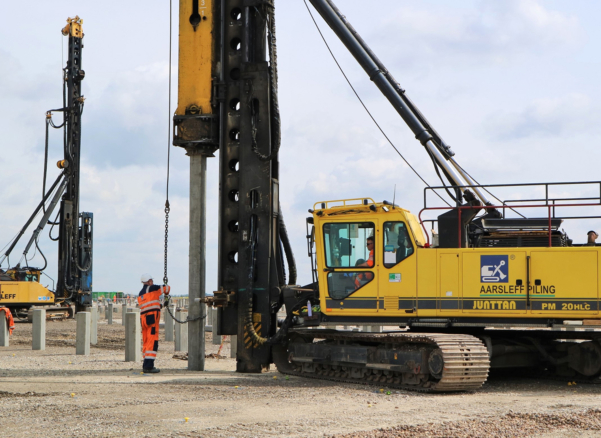
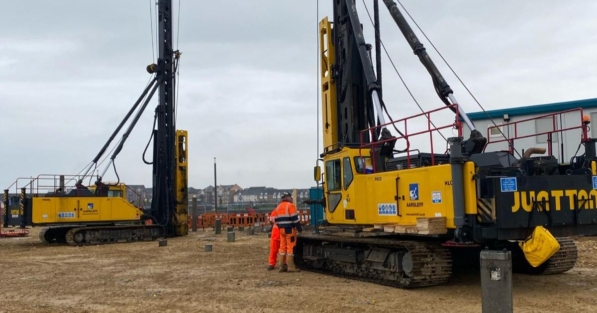
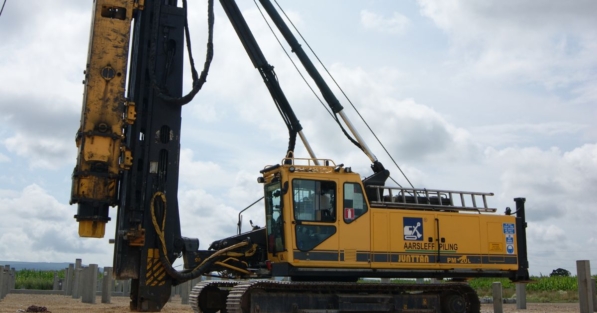
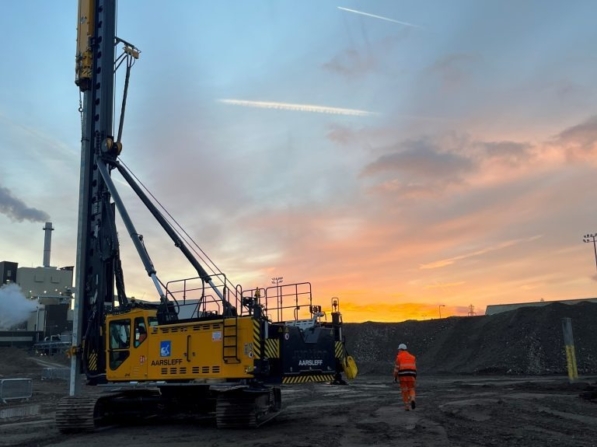
- Following site investigation and design, installation begins using a specialist rig fitted with a displacement auger. As the auger advances, soil is displaced laterally rather than removed. This limits the generation of spoil and maintains ground integrity.
- Once the required depth is reached, a cementitious grout is introduced under controlled pressure. The auger is gradually withdrawn while the column forms in situ. This process creates rigid inclusion piles with consistent geometry and stiffness.
- A load transfer platform is typically constructed above the installed columns. This layer distributes structural loads between the inclusions and the surrounding soil, ensuring balanced performance across the foundation system.
Formation of Controlled Modulus Columns
Controlled Modulus Columns are designed to provide a predictable level of stiffness within the ground. Their formation relies on precise control of installation parameters, including depth, pressure, and material flow.
Unlike traditional piles, these columns do not function independently. Instead, they interact with the surrounding soil to form a composite ground system. This interaction reduces differential settlement and improves load-bearing behaviour.
The spacing and diameter of the columns are determined during the design phase, based on ground conditions and structural requirements. This engineered approach allows for efficient use of materials while maintaining performance standards.
Materials Used in CMC Piling
CMC piling primarily uses a cement-based grout to form the columns. This material is selected for its durability, flow characteristics, and ability to achieve the required stiffness once cured.
The surrounding soil remains an integral part of the system. By combining improved ground with rigid inclusions, the technique avoids the need for large volumes of imported material.
In some cases, variations in grout composition may be introduced to suit environmental conditions or specific engineering demands. The goal remains consistent: to produce stable and reliable CMC piles that perform as designed.
Suitable Ground Conditions for CMC Methods
CMC piling is particularly effective in soils that exhibit low strength or high compressibility. It performs well in:
- Soft clays – Where settlement control is a primary concern and traditional piling may be disproportionate.
- Loose sands – Where improved density and stiffness enhance overall ground performance.
- Made ground – Where variability in composition requires a flexible and controlled solution.
- Organic soils – Where reinforcement is needed to support structural loads without full excavation.
The method adapts to differing site conditions, making it suitable for projects where ground characteristics change across short distances.
Benefits of Using Rigid Inclusion Systems
CMC piling offers several advantages over conventional foundation techniques. By focusing on ground improvement, it delivers both technical and practical benefits:
- Reduces total and differential settlement across structures
- Limits excavation and spoil removal, improving site efficiency
- Provides a controlled and repeatable installation process
- Minimises disturbance in built-up or sensitive environments
- Supports a wide range of structural loads through composite action
In addition, rigid inclusion piles contribute to more sustainable construction practices by reducing material consumption and limiting environmental impact.

Key Considerations for Project Planning
While CMC piling offers flexibility, successful implementation depends on thorough site assessment and design. Ground investigation data plays a central role in determining column layout, depth, and spacing.
Load transfer mechanisms must be carefully considered to ensure compatibility between the structure and the improved ground. Attention to installation quality is equally important, as consistency directly influences performance.
When applied correctly, Controlled Modulus Columns provide a reliable and efficient foundation solution, particularly in challenging ground conditions where alternative methods may prove less practical.

Written by Aarsleff UK
12 August 2026
Aarsleff Ground Engineering is a leading sheet piling supplier and contractor. We specialise in designing and delivering sheet piling solutions across the UK.

Reviewed by Mark Fuller, Piling Director
1 May 2026
Mark Fuller is the Piling Director at Aarsleff Ground Engineering. He has amassed a wealth of experience and knowledge within the specialist piling and ground engineering industry throughout his 20 years of experience in the industry. Mark is directly responsible for the overall driven piling within the business, including technical and operational management of awarded contracts, development of strategic long-term plans and planning of recruitment and resource.
Close