Table of Contents
- About CHD Piling
- What Are the Applications of CHD Piling?
- How Is CHD Piling Installed and What Equipment Is Used?
- Behaviour of Displacement Piles
- What Materials Are Used in CHD Pile Construction?
- Ground Conditions Suitable for CHD Piling
- Advantages of CHD Displacement Piling
- Role of CHD Piling in Modern Foundations
Last updated
12 August 2026
About CHD Piling
CHD, short for Continuous Helical Displacement, refers to a type of displacement piling used to form cast-in-place concrete piles without removing soil from the ground. This method relies on a helical auger that advances into the soil while displacing material laterally, rather than extracting it.
Unlike traditional bored piling techniques, CHD piling does not generate spoil during installation. As the auger progresses, the surrounding ground is compacted, which can improve local soil conditions. Once the required depth is reached, concrete or grout is introduced as the auger is withdrawn, forming a continuous structural element known as a CHD pile.
This approach is commonly selected where ground stability, minimal waste, and controlled installation are required.
What Are the Applications of CHD Piling?
CHD piling is used across a range of construction environments where displacement piles offer advantages over alternative foundation systems.
Typical applications include:
- Commercial developments – Supporting structures where reduced ground disturbance is beneficial.
- Residential housing – Used in sites with variable soils, particularly where consistent installation methods are required.
- Infrastructure projects – Applied in transport and utility works where controlled piling operations are necessary.
- Restricted access sites – Suitable for locations where spoil removal and storage are limited.
- Brownfield developments – Beneficial where ground contamination may restrict excavation or soil handling.
The use of displacement piling in these scenarios allows for a controlled foundation solution while maintaining site efficiency.
How Is CHD Piling Installed and What Equipment Is Used?
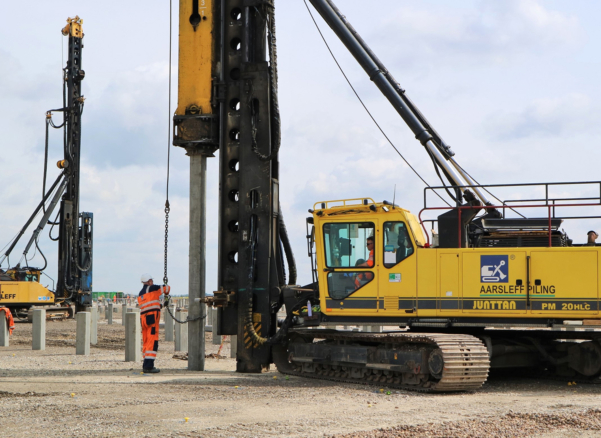
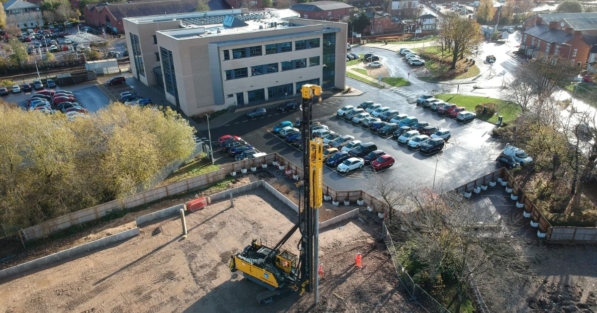
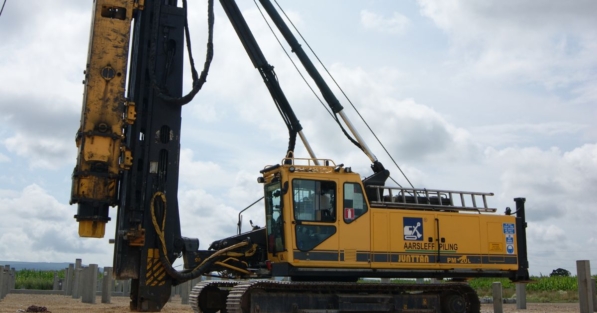
- CHD piling begins with site investigation and pile design, which determine depth, diameter, and load requirements. A piling rig fitted with a helical displacement auger is positioned over the pile location.
- The auger is rotated into the ground, displacing soil outward as it advances. This action compacts the surrounding material, increasing density in the immediate vicinity of the displacement pile. No excavation takes place during this phase.
- Once the target depth is reached, concrete or grout is pumped through the auger’s hollow stem. As the auger is withdrawn, the material fills the void, forming a continuous column. Reinforcement may be introduced either during or immediately after this stage, depending on design requirements.
The result is a cast-in-place displacement pile formed without spoil generation.
Behaviour of Displacement Piles
Displacement piles, including CHD piles, interact with the surrounding soil differently from bored piles. As the auger advances, soil is laterally displaced rather than removed. This can lead to increased confinement and improved ground conditions around the pile shaft.
The installation process may increase load capacity in certain soil types due to this densification effect. Ground response varies depending on soil composition, moisture content, and existing density.
In cohesive soils, displacement may cause lateral pressure changes, whereas in granular soils, displacement may cause compaction and improved particle interlock. These factors are considered during design and installation planning.
What Materials Are Used in CHD Pile Construction?
CHD piles are typically formed using concrete or grout introduced during the withdrawal phase of installation. The material must be suitable for pumping and capable of maintaining continuity within the pile shaft.
Reinforcement is used where structural loads require additional tensile capacity. This may take the form of steel cages or bars inserted into the freshly placed material.
Material selection is influenced by load requirements, environmental exposure, and ground conditions. Consistency during placement remains critical to ensure the integrity of the displacement pile.
Ground Conditions Suitable for CHD Piling
CHD piling is applied across a range of soil types, though suitability depends on ground behaviour during displacement.
- Granular soils such as sands and gravels are generally compatible with displacement piling methods. These soils respond well to lateral movement and compaction, supporting stable pile formation.
- Cohesive soils, including clays, can also accommodate displacement techniques, although installation pressures and ground response must be managed carefully.
- Made ground and mixed soil profiles may present variable conditions. In such cases, assessment is required to determine whether a CHD pile offers an appropriate solution.
Ground investigation remains essential in determining feasibility and ensuring that displacement effects do not adversely impact adjacent structures.
Advantages of CHD Displacement Piling
CHD piling offers several advantages over other foundation methods, particularly when displacement piling is preferred.
Key benefits include:
- Elimination of spoil, reducing material handling and site waste.
- Compaction of the surrounding soil during installation improves local ground conditions.
- Controlled installation process with consistent pile formation.
- Reduced reliance on excavation, supporting cleaner site operations.
- Suitable for a range of soil types and project requirements.
These characteristics make displacement piles a practical option for projects requiring efficient and controlled foundation solutions.
Role of CHD Piling in Modern Foundations
CHD piling forms part of a broader group of displacement piling techniques used in foundation engineering. Its application supports structural stability while limiting disruption to existing ground conditions.
By forming piles in place without excavation, the method provides an alternative to traditional bored systems. Selection depends on technical requirements, ground conditions, and project constraints.
Within modern construction, CHD piles continue to be used where displacement piling offers advantages in both installation and performance.

Written by Aarsleff UK
12 August 2026
Aarsleff Ground Engineering is a leading sheet piling supplier and contractor. We specialise in designing and delivering sheet piling solutions across the UK.

Reviewed by Mark Fuller, Piling Director
30 April 2026
Mark Fuller is the Piling Director at Aarsleff Ground Engineering. He has amassed a wealth of experience and knowledge within the specialist piling and ground engineering industry throughout his 20 years of experience in the industry. Mark is directly responsible for the overall driven piling within the business, including technical and operational management of awarded contracts, development of strategic long-term plans and planning of recruitment and resource.
Close