Table of Contents
- About Pile Caps
- Where Are Pile Caps Commonly Used?
- How Do Pile Caps Transfer Structural Loads?
- Structure and Reinforcement in Pile Caps
- Materials Used in Pile Cap Construction
- Ground and Design Considerations for Caps
- Benefits of Using Pile Caps in Foundations
Last updated
12 August 2026
About Pile Caps
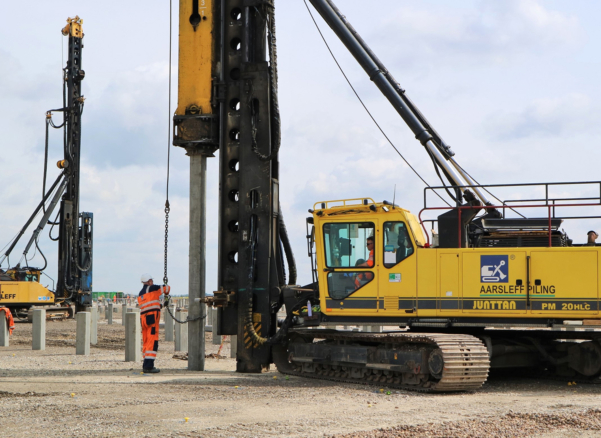
Pile caps are reinforced concrete elements used within piled foundations to connect individual piles and distribute structural loads. Positioned above installed piles, a pile cap forms a link between the substructure and the building or infrastructure above.
Rather than interacting directly with the soil, as piles do, pile caps transfer loads from columns or walls to a group of piles. This creates a unified system capable of supporting varying structural demands across a foundation footprint.
Design and layout depend on factors such as load requirements, pile arrangement, and ground conditions. Each pile cap must be engineered to ensure forces are shared efficiently between connected piles.

Where Are Pile Caps Commonly Used?
Pile caps are present in a wide range of construction projects where piled foundations are required. Their role becomes essential when multiple piles are needed to support a single structural element.
- Commercial structures – Used beneath columns and cores in offices, retail units, and industrial buildings.
- Infrastructure projects – Found in bridge supports, viaducts, and transport structures where load distribution is critical.
- Residential developments – Applied in housing schemes where grouped piles support load-bearing walls or frames.
- Marine construction – Supporting piers and quay structures, often combined with durable reinforcement systems.
- Energy and utilities – Used in substations and plant bases where concentrated loads require stable transfer into the ground.
These applications highlight that pile caps are a key part of many foundation systems rather than standalone elements.
How Do Pile Caps Transfer Structural Loads?
Pile caps function by spreading loads from a structure across several piles. When a column or wall applies downward force, that load is transferred to the cap and distributed through its reinforced-concrete body.
The geometry of the cap plays a central role. Forces move through the concrete and into each pile, reducing the risk of overloading a single element. This arrangement supports balanced load sharing, even where ground conditions vary beneath the surface.
Connections between piles and the cap must be secure. Reinforcement within the cap ensures that tensile forces are resisted, allowing the structure to perform as intended under different loading scenarios.
Structure and Reinforcement in Pile Caps
A pile cap typically consists of reinforced concrete with embedded steel designed to handle both compression and tension. Pile cap reinforcement is arranged to suit the cap’s shape and loading pattern, ensuring structural integrity throughout its lifespan.
Reinforcement may include:
- Steel bars arranged in grids or cages
- Additional links to manage shear forces
- Anchoring elements connecting piles to the cap
The layout varies depending on design requirements. Larger caps supporting higher loads often require more complex reinforcement arrangements, while smaller configurations may follow simpler patterns.
Durability also influences material selection.
Materials Used in Pile Cap Construction
Concrete forms the primary material in pile caps, selected for its strength and ability to distribute loads. The mix design is chosen to suit project conditions, including exposure, durability, and structural performance.
Steel reinforcement provides tensile capacity. Without it, concrete alone would not resist forces generated within the cap. The combination of concrete and steel creates a composite element capable of handling complex loading conditions.
In some cases, additional treatments or coatings may be applied to enhance durability, particularly where environmental exposure could affect long-term performance.
Ground and Design Considerations for Caps
While pile caps do not directly improve soil, their design must reflect ground conditions beneath the piles. Load distribution depends on how each pile interacts with the surrounding soil, so accurate ground investigation remains essential.
Spacing between piles influences cap size and reinforcement layout. Wider spacing may increase bending forces within the cap, requiring careful design to maintain performance.
Construction constraints also play a role. Access, excavation depth, and sequencing can affect how pile caps are installed and integrated into the overall foundation system.
Benefits of Using Pile Caps in Foundations
Pile caps offer several advantages when incorporated into a piled foundation system. Their presence ensures loads are managed effectively across multiple elements.
- Distributes structural loads evenly across piles
- Connects individual piles into a unified system
- Supports complex foundation layouts with varying loads
- Enhances the overall stability of the structure above
- Allows flexibility in pile arrangement and design
In addition, well-designed pile caps contribute to long-term structural performance by maintaining consistent load transfer, even where ground conditions are less uniform.

Written by Aarsleff UK
12 August 2026
Aarsleff Ground Engineering is a leading sheet piling supplier and contractor. We specialise in designing and delivering sheet piling solutions across the UK.

Reviewed by Mark Fuller, Piling Director
1 May 2026
Mark Fuller is the Piling Director at Aarsleff Ground Engineering. He has amassed a wealth of experience and knowledge within the specialist piling and ground engineering industry throughout his 20 years of experience in the industry. Mark is directly responsible for the overall driven piling within the business, including technical and operational management of awarded contracts, development of strategic long-term plans and planning of recruitment and resource.
Close