What Are King Post Walls?
Table of Contents
- About King Post Retaining Walls
- The History of King Post Walls
- Common Uses
- King Post Retaining Wall Design
- King Post Wall Installation
- Advantages
Last updated
23 September 2025
About King Post Retaining Walls
A king post wall, also known as a Berlin wall or soldier pile, is a retaining wall system. King post walls are known for their versatility and ease of installation. This system comprises isolated steel columns, known as king posts, which are installed along the line of the proposed retaining wall, typically at centres between 1 and 3m with spacing dictated by the width of the wall panels. The space between the king posts is filled, over the retained height, using a variety of different solutions but most commonly a precast concrete panel.

The History of King Post Walls
King post walls are some of the oldest forms of retaining wall systems used in deep excavations. They have successfully been used since the late 18th Century in metropolitan cities like New York, Berlin, and London. Initially crafted from timber panels, these retaining walls were pivotal for supporting bridges, houses, and large buildings. Over time, the evolution of materials and engineering techniques led to the adaptation of king post walls into more modern construction forms, integrating steel and concrete for maximum stability and durability.
Common Uses
King post walls are ideal and used for:
- Different earth retention applications and heights in various ground conditions, including rock
- Basement construction
- Flood defence walls
- Embankment retention
King Post Retaining Wall Design
King post walls can be designed to Eurocode 7 or British standards and can be analysed in temporary or permanent conditions. The design life of king post walls is generally 50 years or more. This duration can vary depending on specific project requirements or environmental conditions to which the wall will be exposed. [1]
The design of a king post retaining wall usually requires knowledge of the retaining material, the water table, the ground bearing capacity, soil conditions and any site constraints.

King Post Wall Installation
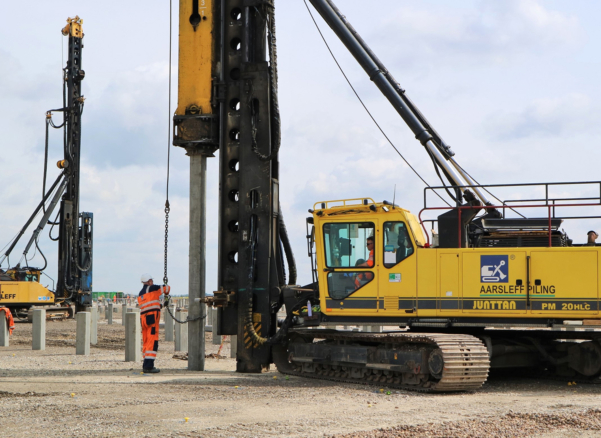
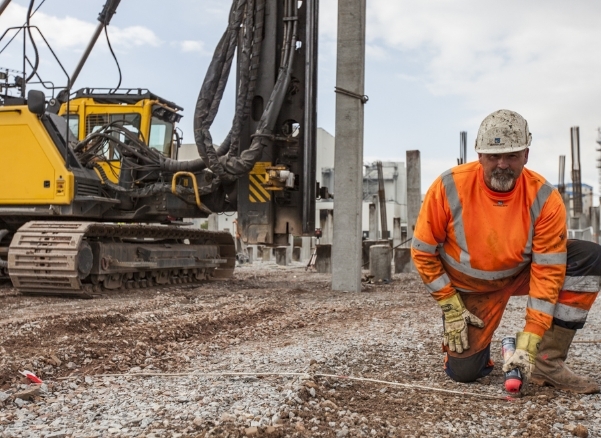
The installation of king post walls involves drilling a bore hole with a high-powered continuous flight auger (CFA), large diameter or restricted access piling rig and then filling it with concrete and installing an H beam, Universal Columns (UC’s), CFA piles or SFA piles. This allows concrete prestressed panels or sleepers to be inserted between the webs of the H sections. They may be driven directly into the ground, depending on soil conditions. The surrounding earth is then excavated to leave the finished, embedded retaining structure.
For a visual explanation of the installation of king post walls, watch our video:
Advantages
The main advantages of king post walls are:
- Quick and straightforward process to build, making it a smooth transition on handing over to follow on trade
- Installation is versatile and adjustments can be made in the field easily to accommodate changes
- Ideal for different retention applications and heights
- They can be constructed top-down and bottom-up
- Relatively silent and vibration-free installation
- Can be cheaper when compared to other types of retaining walls, such as sheet piled walls and concreted piled walls
- Procurement of locally sourced materials
- King post corners can be fabricated off-site so that no on-site hot works are required on site. This reduces risk on site as well as saving time and money
- Cost-effective system for use on hard ground
- Can be tied back with ground anchors
- Low spoil generated on-site
- Piling is unaffected by groundwater

Written by Aarsleff UK
23 September 2025
Aarsleff Ground Engineering is a leading sheet piling supplier and contractor. We specialise in designing and delivering sheet piling solutions across the UK.

Reviewed by John Storry, Retaining Walls Director
17 February 2025
John Storry is our Operations Director for Specialist Retaining Walls, having amassed a wealth of experience and knowledge in the construction market. John has held senior positions within several companies already well-established in the sheet piling sector and has been with Aarsleff since 2016. John operates on a practical, estimating, commercial and development level to capitalise and gain the traction needed to take Aarsleff’s sheet piling arm of the business to the next level.
Close