What are Precast Ground Beams Systems?
Table of Contents
- About Precast Ground Beam Systems
- Applications in Construction Projects
- Installation Process and Site Integration
- Integration With Piled Foundations
- Materials and Structural Considerations
- Ground Conditions and Suitability
- Advantages of Precast Ground Beam Systems
Last updated
6 July 2026
About Precast Ground Beam Systems
Precast ground beam systems are structural foundation elements designed to transfer and distribute loads across prepared ground or between discrete supports. Unlike in-situ concrete beams, these units are manufactured off-site and delivered to the site in a finished state, ready for installation.
Production takes place under controlled factory conditions, allowing for consistency in dimensions, reinforcement placement, and material quality. Once installed, the beams form part of the substructure, supporting load-bearing walls, floors, or other structural components.
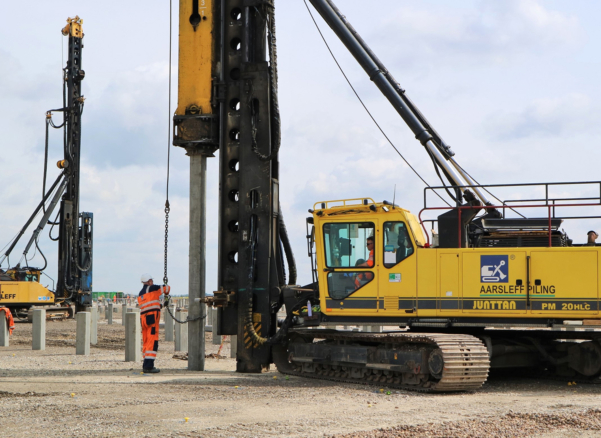
Precast ground beams are frequently used in conjunction with piled foundations, where they span between pile caps or bearing points to create a continuous load distribution system.
Applications in Construction Projects
Precast ground beam systems are used across multiple sectors where foundation performance, construction efficiency, and repeatability are required.
Typical applications include:
- Residential developments – Used in housing schemes where standardised layouts allow for efficient installation of pre-engineered components.
- Commercial buildings – Applied in retail, office, and industrial developments where programme constraints require reduced on-site construction time.
- Infrastructure projects – Supporting structures such as bridges, service installations, and transport-related facilities
- Challenging ground conditions – Combined with piling systems to transfer loads beyond weak surface soils.
Selection of precast ground beams is influenced by structural design requirements, ground conditions, and construction sequencing.
Installation Process and Site Integration
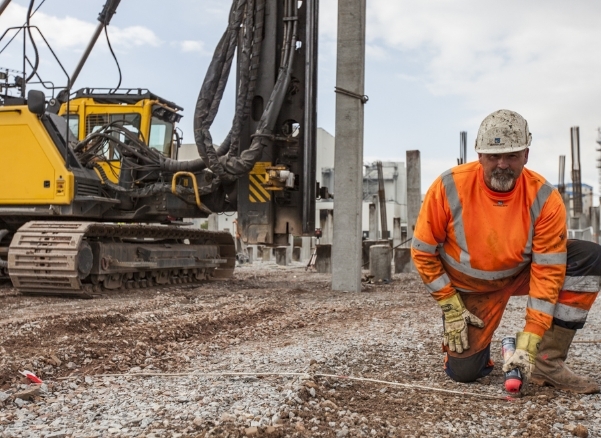
- Installation follows completion of ground preparation and, where required, piling works. Pile caps or bearing points are set out in accordance with the structural layout.
- Precast beams are delivered to the site and positioned using lifting equipment. Placement is carried out within specified tolerances to ensure proper alignment with the overall structure. Beams are seated onto prepared supports, which may include pile caps, pads, or ground-bearing elements.
- Connections between beams and supporting elements may involve grouting, mechanical fixings, or cast-in connectors, depending on the design. Once installed, the beams form a continuous framework across the foundation area.
This system allows subsequent construction activities to proceed without the need for curing periods associated with in-situ concrete.
Integration With Piled Foundations
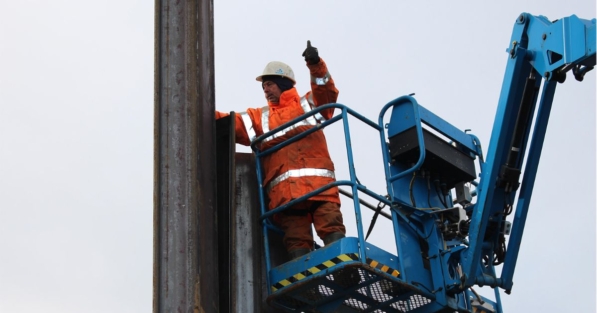
Precast ground beams are commonly integrated with piled foundations to form a combined structural system. In this configuration, piles transfer loads to deeper, more stable strata, while beams distribute those loads horizontally across the structure.
This arrangement is applied where near-surface soils do not provide adequate bearing capacity. By linking individual pile supports, the beam system reduces differential settlement and improves load distribution.
Accurate coordination between pile installation and beam placement is required to maintain design tolerances and ensure structural performance.
Materials and Structural Considerations
Precast ground beams are typically constructed from reinforced concrete. Internal steel reinforcement provides resistance to bending and shear forces, while the concrete matrix offers durability in ground-exposure conditions.
Manufacturing in a controlled environment allows for consistent curing and quality assurance. This reduces variability between units and supports predictable structural behaviour.
Design parameters may include variations in beam depth, width, reinforcement configuration, and connection details. These are determined based on load requirements, span lengths, and site-specific conditions.
Durability considerations include resistance to moisture, chemical exposure, and long-term environmental effects.
Ground Conditions and Suitability
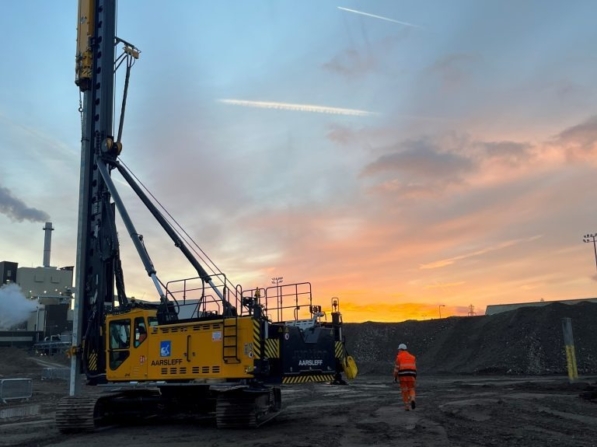
Precast ground beam systems are suited to sites where traditional shallow foundations are not appropriate due to soil conditions. Weak, variable, or compressible soils often require a piled solution combined with beams to achieve adequate load transfer.
Made ground, cohesive soils such as clay, and mixed soil profiles may not provide uniform support for strip foundations. In these cases, precast beams distribute loads between stable points, reducing reliance on surface bearing capacity.
Site investigation informs the selection of foundation type, with factors such as soil strength, settlement potential, and groundwater conditions influencing design decisions.
Advantages of Precast Ground Beam Systems
Precast ground beam systems provide several functional advantages in foundation construction:
- Reduced on-site construction time due to off-site manufacturing and immediate installation.
- Lower labour requirements during installation compared to in-situ methods.
- Consistent quality resulting from controlled production processes.
- Improved accuracy in repetitive layouts across large developments.
- Reduced exposure to weather-related delays during foundation works.
These characteristics contribute to efficient construction sequencing and improved coordination between trades.
Precast ground beam systems remain a widely used solution in foundation design, particularly where ground conditions and project requirements favour a controlled, repeatable approach to load distribution.

Written by Aarsleff UK
6 July 2026
Aarsleff Ground Engineering is a leading sheet piling supplier and contractor. We specialise in designing and delivering sheet piling solutions across the UK.

Reviewed by Mark Fuller, Piling Director
30 April 2026
Mark Fuller is the Piling Director at Aarsleff Ground Engineering. He has amassed a wealth of experience and knowledge within the specialist piling and ground engineering industry throughout his 20 years of experience in the industry. Mark is directly responsible for the overall driven piling within the business, including technical and operational management of awarded contracts, development of strategic long-term plans and planning of recruitment and resource.
Close