What Are Raft Foundations?
Table of Contents
- Definition and Structural Purpose of Raft Foundations
- Ground Conditions and Site Suitability For Raft Foundations
- What Are Reinforced Raft Foundations?
- Raft Foundation on Piles Explained
- What Is the Construction Sequence and Installation of Raft Foundations?
- Raft Foundation Calculation Factors
- Functional Advantages in Foundation Design
Last updated
12 August 2026
Definition and Structural Purpose of Raft Foundations
Raft foundations are large reinforced concrete slabs designed to support structures by spreading loads across a broad ground area. Rather than transferring weight through isolated footings, this foundation type distributes pressure more evenly beneath an entire building footprint.
This arrangement is regularly selected where shallow ground conditions cannot provide consistent bearing support for traditional strip or pad foundations. By increasing the contact area with the surrounding soil, settlement across the structure can be reduced.
A simple raft foundation may support smaller developments where loading conditions remain relatively uniform. Larger schemes often require more complex reinforced systems capable of resisting varying structural forces.
Ground Conditions and Site Suitability for Raft Foundations
Raft foundations are commonly used on sites with weak or variable ground conditions. Cohesive soils, made ground, compressible layers, and areas affected by groundwater may influence foundation selection during early design stages.
Where surface soils provide inconsistent bearing capacity, a raft arrangement can reduce localised stress concentrations beneath structural elements.
This foundation method may also be considered where:
- Column spacing remains closely arranged
- Settlement control forms part of the design strategy
- Excavation depth requires limitation
- Structural loads need wider distribution
- Ground conditions vary across the site footprint
Detailed site investigation informs the overall foundation approach and supports engineering assessment during structural planning.
What Are Reinforced Raft Foundations?
A reinforced raft foundation incorporates steel reinforcement within concrete to improve resistance against bending forces, shear stresses, and differential settlement.
Reinforcement layouts vary according to structural loading requirements and soil behaviour beneath the slab. Additional thickening may be introduced beneath heavily loaded sections such as columns, retaining walls, or core structures.
Depending on project requirements, reinforced raft foundation systems may include:
- Ground beams integrated within slab construction
- Thickened load-bearing zones
- Edge stiffening sections
- Waterproofing components
- Thermal insulation layers
Controlled reinforcement placement supports structural continuity across the foundation area while improving long-term performance under varying ground conditions.

Raft Foundation on Piles Explained
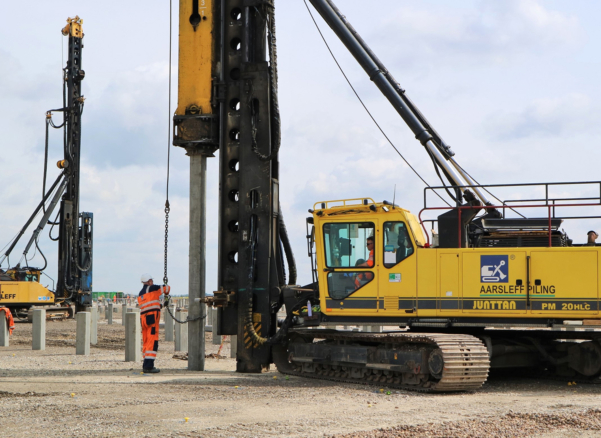
A raft foundation on piles combines shallow and deep foundation methods within a single structural system. In this arrangement, piles transfer part of the building load into deeper bearing strata, while the raft distributes the remaining forces across the surface soils.
This approach may be selected where shallow ground alone cannot provide sufficient support, yet full deep foundation solutions are not considered necessary across the entire structure.
Piled raft systems are regularly associated with:
- Commercial developments
- Infrastructure projects
- Sites containing compressible soils
- Coastal developments
Accurate coordination between piling works and raft construction remains essential during installation. Structural tolerances, pile positioning, and reinforcement continuity all influence final performance.
What Is the Construction Sequence and Installation of Raft Foundations?
Raft foundation construction generally begins after excavation and ground preparation. Formation levels are trimmed to specification before reinforcement placement and shuttering operations commence.
Concrete is then poured across prepared areas to form a continuous structural slab. Depending on design requirements, installation may involve staged pours, integrated drainage provisions, or thickened reinforcement zones.
Construction activities commonly include:
- Ground preparation and excavation
- Compaction of formation levels
- Placement of sub-base materials
- Reinforcement installation
- Formwork positioning
- Concrete placement and finishing
Where a raft foundation on piles has been specified, piling operations are completed before reinforcement and slab construction proceed.
Raft Foundation Calculation Factors
Raft foundation calculation involves assessment of structural loading, soil interaction, slab thickness, reinforcement requirements, and settlement behaviour.
Engineering analysis considers several variables during design development, including:
- Ground bearing capacity
- Structural load distribution
- Column spacing
- Soil compressibility
- Bending moments within slab areas
- Shear resistance requirements
Calculations also influence reinforcement arrangement, slab geometry, and any additional stiffening elements required within the overall system.
Foundation design remains closely linked to geotechnical investigation data and structural engineering assessment throughout the planning process.
Functional Advantages in Foundation Design
Raft foundations continue to be used in many modern construction projects due to their adaptability across varying site conditions. Their ability to distribute loads over wider areas can assist where ground variability presents challenges for traditional shallow foundations.
A simple raft foundation may provide an efficient solution for smaller structures with moderate loading demands, while reinforced systems support more complex developments that require greater structural capacity.
Where settlement management, load distribution, and challenging soil conditions influence foundation selection, raft foundation systems remain a widely adopted option within contemporary construction and ground engineering projects.

Written by Aarsleff UK
12 August 2026
Aarsleff Ground Engineering is a leading sheet piling supplier and contractor. We specialise in designing and delivering sheet piling solutions across the UK.

Reviewed by Mark Fuller, Piling Director
14 May 2026
Mark Fuller is the Piling Director at Aarsleff Ground Engineering. He has amassed a wealth of experience and knowledge within the specialist piling and ground engineering industry throughout his 20 years of experience in the industry. Mark is directly responsible for the overall driven piling within the business, including technical and operational management of awarded contracts, development of strategic long-term plans and planning of recruitment and resource.
Close