What is Expanded Piling?
About Expanded Piling
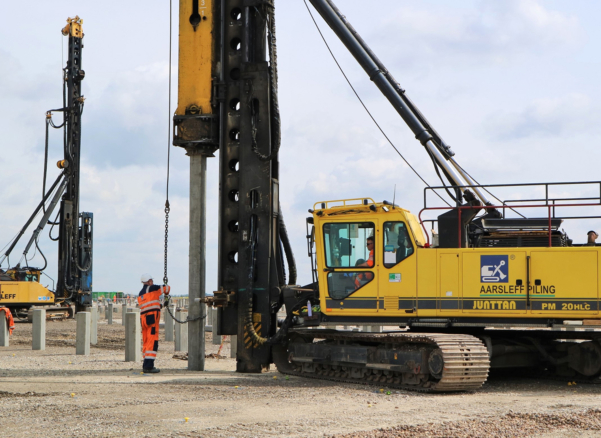
Expanded piling is a foundation technique in which the base or shaft of a pile is enlarged during installation to improve load-bearing capacity. This approach is part of expanded construction, in which the pile geometry increases below ground level, allowing greater interaction with the surrounding soil.
Rather than relying solely on shaft friction, expanded piles develop additional support through an enlarged base. This creates a broader bearing surface, improving stability and reducing settlement under structural loads.
Expanded piling is typically used where ground conditions demand higher capacity without increasing pile length. It provides an efficient solution in constrained environments where deeper excavation may not be practical.
Where Expanded Piling is Commonly Used
Expanded piling is applied across projects where enhanced load distribution and ground engagement are required. Typical applications include:
- Commercial buildings – Supporting columns and core structures where higher loads must be managed within limited foundation footprints.
- Infrastructure works – Used in bridge supports and transport schemes where stable foundations are critical.
- Residential developments – Applied where ground conditions vary, requiring improved bearing performance.
- Industrial sites – Supporting heavy plant and equipment where concentrated loads demand reinforced foundations.
- Restricted-access locations – Suitable where increasing the pile diameter below ground reduces the need for additional piles.
This adaptability makes expanded piling a practical choice within expanded construction projects.
How Expanded Piles are Installed
- Installation begins with the formation of a bore or driven shaft, depending on the selected method. Once the pile reaches the required depth, the base is expanded using mechanical tools or controlled pressure techniques.
- This expansion creates a wider section at the bottom of the pile. Concrete is then introduced to fill the enlarged cavity and form a solid structural element. The increased base area allows loads to spread more effectively into the surrounding ground.
- In some variations, expansion may occur along sections of the shaft rather than only at the base. This further enhances interaction between the pile and the soil, contributing to the overall stability of the foundation system.
Techniques Used in Expanded Construction
Several methods are used to achieve expansion within piling systems, each suited to specific site conditions:
- Under-reamed piling – A mechanical tool enlarges the base of the borehole, forming a bulb-shaped section.
- Pressure-expanded piles – Controlled pressure is applied to expand the surrounding soil, increasing contact area.
- Segmental expansion – Expansion occurs at intervals along the shaft, improving load transfer across multiple zones.
Each technique is part of an expanded construction approach, allowing engineers to tailor it to ground conditions and structural demands.
Materials Used in Expanded Piling
Expanded piles are generally constructed using reinforced concrete. This material provides the compressive strength required to support structural loads while maintaining durability within the ground.
Steel reinforcement is incorporated to manage tensile forces and maintain structural integrity. The arrangement of reinforcement depends on the design of the expanded sections and the loads applied to the pile.
In certain environments, additional measures may be introduced to enhance resistance to aggressive ground conditions, ensuring long-term performance.
Ground Conditions Suited to Expanded Piling
Expanded piling performs effectively in soils where increased bearing area can improve load capacity. Suitable conditions often include:
- Cohesive soils – Where expansion creates a stable base that resists settlement.
Loose or variable ground – Where additional contact area enhances load distribution. - Sites with limited depth potential – Where increasing base size provides an alternative to deeper piling.
- Ground with moderate strength – Where expansion can improve interaction without excessive displacement.
Highly unstable or water-bearing soils may require alternative techniques or additional support measures during installation.
Benefits of Expanded Piling Techniques
Expanded piling offers several advantages within foundation design, particularly when increased capacity is required without extending pile depth:
- Improves load-bearing performance through enlarged base geometry
- Reduces the number of piles needed within a foundation layout
- Enhances stability in variable ground conditions
- Supports efficient use of materials in expanded construction
- Adapts to site constraints where deeper excavation is limited
In addition, expanded piling contributes to a more efficient foundation system by maximising interaction between the pile and surrounding soil, supporting long-term structural performance.

Written by Aarsleff UK
31 July 2026
Aarsleff Ground Engineering is a leading sheet piling supplier and contractor. We specialise in designing and delivering sheet piling solutions across the UK.

Reviewed by Mark Fuller, Piling Director
1 May 2026
Mark Fuller is the Piling Director at Aarsleff Ground Engineering. He has amassed a wealth of experience and knowledge within the specialist piling and ground engineering industry throughout his 20 years of experience in the industry. Mark is directly responsible for the overall driven piling within the business, including technical and operational management of awarded contracts, development of strategic long-term plans and planning of recruitment and resource.
Close