What is Rotary Piling?
About Rotary Piling
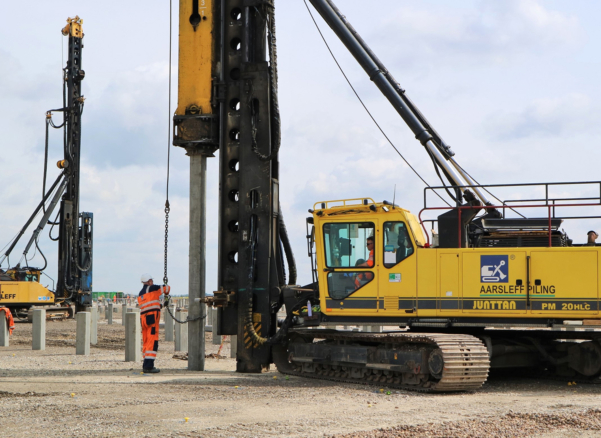
Rotary piling is a foundation installation method that uses rotating drilling equipment to form piles in the ground. This approach creates boreholes that are later filled with concrete and reinforcement, forming a pile foundation capable of supporting structural loads.
Unlike driven systems, rotary piling removes or displaces soil through controlled drilling. This allows installation in a wide range of ground conditions, including dense soils and rock. The method is widely used across piling foundations where precision and adaptability are required.
Rotary piling forms part of modern pile foundations, offering a reliable solution for projects that demand consistent performance beneath complex structures.
Where Rotary Piling is Commonly Used
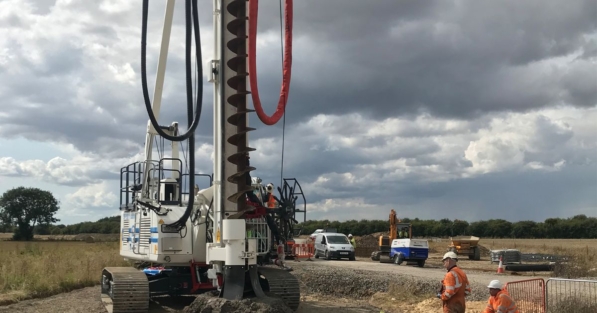
Rotary piling is specified across multiple sectors due to its flexibility and ability to handle varied ground conditions. Typical applications include:
- Commercial developments – Supporting high-load structures such as offices, retail spaces, and mixed-use buildings.
- Infrastructure works – Used in bridges, highways, and rail projects where deep and stable pile foundations are essential.
- Residential construction – Applied in housing developments where ground conditions require engineered support systems.
- Energy and industrial sites – Providing foundations for heavy plant, substations, and processing facilities.
- Urban environments – Suitable for confined sites where controlled drilling reduces disturbance to surrounding structures.
This range reflects how rotary piling adapts to both large-scale and restricted-access projects.
How Rotary Piling is Installed
- Installation begins with a specialist rig equipped with a rotating drilling tool. This tool advances into the ground, forming a borehole to the required depth. Soil may be removed or displaced depending on the selected technique.
- In certain conditions, temporary casing or support fluids are introduced to maintain bore stability. These measures prevent collapse and allow safe continuation of drilling, particularly in loose or water-bearing soils.
- Once the bore reaches design depth, reinforcement is placed within the shaft. Concrete is then introduced, forming a structural element that integrates into the overall piling foundations system. The result is a completed pile foundation capable of transferring loads into deeper, more stable ground layers.
Variations Within Rotary Piling Methods
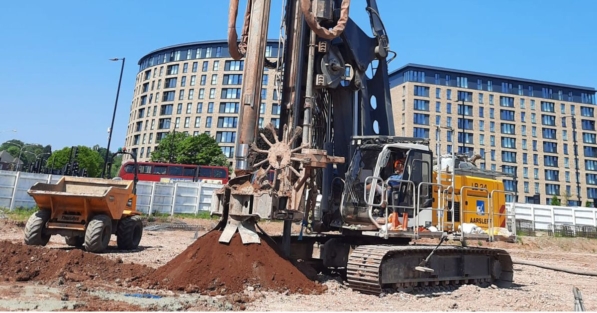
Rotary piling includes several techniques, each suited to specific ground conditions and structural requirements:
- Bored piling – Involves drilling an open borehole, which is later filled with reinforcement and concrete.
- Cased rotary piling – Uses a steel casing to support the bore during installation, particularly in unstable soils.
- Continuous flight auger systems – Combine drilling and concrete placement in a single operation, reducing the need for open excavation.
- Rotary displacement methods – Displace soil laterally rather than removing it, thereby limiting spoil generation.
These variations allow engineers to select the most appropriate solution for each project, ensuring compatibility with ground conditions and design requirements.
Materials Used in Rotary Pile Construction
Rotary piles are typically formed using concrete and steel reinforcement. Concrete provides compressive strength, enabling the pile to support significant structural loads within pile foundations.
Reinforcement is installed to manage tensile forces and improve overall durability. Steel cages or bars are commonly used, designed to suit the project’s load demands and environmental conditions.
In some cases, additional measures such as protective coatings or specialised concrete mixes may be specified to enhance performance in aggressive environments.

Ground Conditions Suited to Rotary Piling
Rotary piling performs effectively across a wide spectrum of soils and geological conditions. It is often selected where other methods may be less suitable.
- Dense soils and clays – Drilling equipment allows controlled penetration without excessive vibration.
- Water-bearing strata – Use of casing or support fluids maintains bore stability during installation.
- Rock formations – Rotary tools can cut into harder materials, enabling deeper foundation solutions.
- Variable ground profiles – Adaptability of the method supports consistent installation across changing conditions.
This flexibility makes rotary piling a dependable choice for projects requiring robust, adaptable foundations.
Benefits of Rotary Piling Techniques
Rotary piling offers several advantages when used within modern pile foundations:
- Provides precise control over pile depth and alignment
- Suitable for complex and variable ground conditions
- Reduces vibration compared with driven piling methods
- Allows installation in restricted or urban locations
- Supports high load capacities through engineered design
In addition, the method integrates well with a wide range of structural systems, making it a practical solution for both large and small-scale developments.


Written by Aarsleff UK
27 May 2026
Aarsleff Ground Engineering is a leading sheet piling supplier and contractor. We specialise in designing and delivering sheet piling solutions across the UK.

Reviewed by Mark Fuller, Piling Director
1 May 2026
Mark Fuller is the Piling Director at Aarsleff Ground Engineering. He has amassed a wealth of experience and knowledge within the specialist piling and ground engineering industry throughout his 20 years of experience in the industry. Mark is directly responsible for the overall driven piling within the business, including technical and operational management of awarded contracts, development of strategic long-term plans and planning of recruitment and resource.
Close